
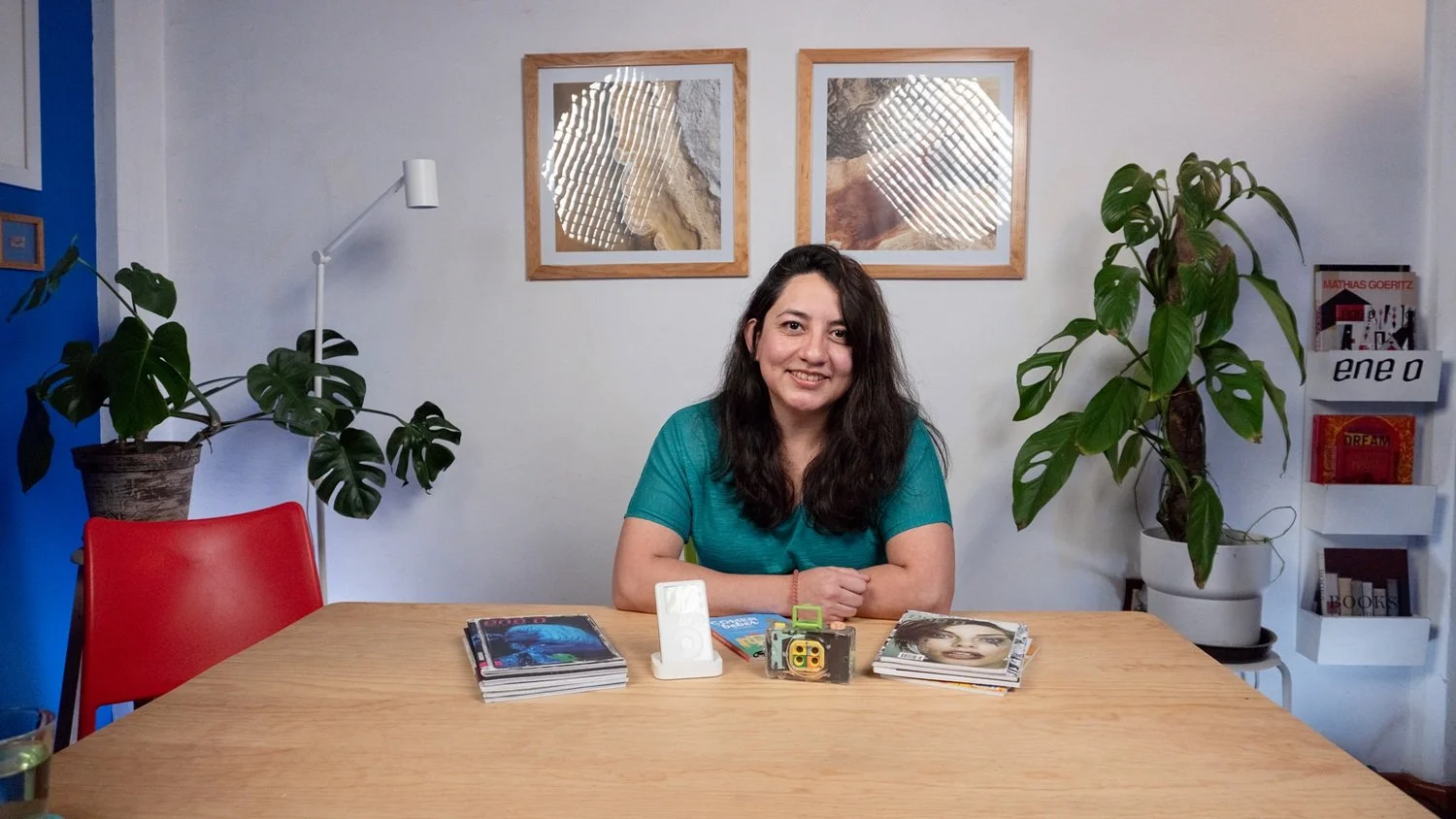
In episode 254, Peter Hayward speaks to Abril Chimal who has a background in graphic design and a post-graduate specialisation in Design of Tomorrow at CENTRO in Mexico City. She is currently the Chief Pollinator for the Participatory Futures Global Swarm and Technical Editor for the Journal of Futures Studies, and professor of Creativity and Futures Thinking at CENTRO.
Interviewed by: Peter Hayward
Links
LinkedIn - Abril Chimal
Women Who Future(s) — APF Compass, Special Edition — A special publication highlighting diverse perspectives and contributions to futures thinking. Explore the publication
Reimagining the Hemisphere — Journal of Futures Studies — A symposium exploring plural futures, decolonial perspectives, and critical approaches from Latin America and the Global South. Explore the publications
Bridging Worlds: Sci-Fi & Foresight — Podcast — Conversations exploring the intersections of science fiction, imagination, and futures studies. Listen to the podcast
Futures of Humanitarian Aid: A Speculative Lens — An exploration of humanitarian futures through speculative thinking and critical imagination. Read the article
Using Anticipatory Experimentation to Explore and Create Futures of Safety for Women in Mexico — Research exploring anticipatory experimentation and alternative futures for women's safety in Mexico. Read the article
Transcript
Peter Hayward: Ours is very literal field, we explain our imagining in words mostly. And we encourage our clients to do the same. But are the words we use an enabler or a limiter?
Abril Chimal: I have another project that it's called Without Words that I started with a colleague of mine Lena Tünkers and she was living here in Mexico City. And she was here because she wanted to practice her Spanish. And when we were hanging out just like friends we were talking in Spanish. But when we start talking about work, we'd shift our language to English because we couldn't express ourselves in other language, because most of the concepts are in English and they don't have a translation. Foresight doesn't have a translation in Spanish. So it was very complicated to us to speak and I don't speak German, so we needed to shift and we came to this concept of pollution of words. If you are running a workshop where there are different nationalities, cultures, how can you imagine those futures if there are no literal translations from where you are coming from? In Spanish, for example, we have a word that it's apapacho, and it's like a hug with the heart. So how can I share with you that feeling if you are not from Mexico? And how can you imagine a future if you don't know how does that feel?
Peter Hayward: That is my guest today on FuturePod. Abril Chimal. Abril has a background in graphic design and a post-graduate specialisation in Design of Tomorrow at CENTRO in Mexico City. She is currently the Chief Pollinator for the Participatory Futures Global Swarm and Technical Editor for the Journal of Futures Studies, and professor of Creativity and Futures Thinking at CENTRO.
Peter Hayward: Welcome to FuturePod, Abril Chimal.
Abril Chimal: Thank you so much, Peter, for having me here. I'm super excited to start with this conversation.
Peter Hayward: Yeah, I'm excited too.
So at FuturePod, the first question we ask our guests is the story question. So what's the Abril Chimal story question? How did you get involved with the futures and foresight community?
Abril Chimal: Uh, how do I get involved within the foresight and futures community? That's, uh, I always find interesting of, of, uh, hearing that because it was through ad- advertising actually, and it started here in Mexico City.
So it came from the future sideways. And, um, I s- I spent eight years working on, on adverti- advertising agencies in Mexico City, uh, working for big brands like Uber, Coca-Cola, Google, MasterCard, and a lot of other brands that I used to work with. And at the time, here in Mexico was, like, something very, uh, new to the field, that it was design thinking.
And design thinking evolved in Mexico to design futures. And I study because of that and because colleagues and other, uh, professors that I have in the past. I start the program of, uh, Design of Tomorrow in, at CENTRO, a university dedicated to the creative industries in Mexico City. And that's where one of my
I met my mentors, because we have international mentors, and two of, well, one of them is Jose Ramos that you know pretty well. I do. I
Peter Hayward: do know Jose,
Abril Chimal: yes. And Jake Dunagan So both of them were my inspiration within to futures. And then I ha- was lucky enough, uh, when I finished my post-graduate program, one of the things that Karla Paniagua, that is the director of the program, she always ask us, like, are you ready to change?
Because change won't happen just, like, with the things that you know, but your life will be changing as well, not just your professional life but also, like, the whole spectrum of life in general." And I was like, "Yes." So then after I finished the program, I left advertising because I realized that was nothing that I wanted to do, and I didn't like the people in the field and a lot of things.
And so I started teaching design fiction for undergraduate students, for filmmakers, designers, marketers, a lot of, uh, different field, like... Sorry. I'm going to pause there. A lot of, um different fields on the creative industry. And then I had the privilege to assist Jose Ramos in a workshop, and it was the last time that he was here in Mexico City before COVID.
So it was an interesting time because it was COVID, but also here in Mexico City was something, it was arising something around the future of women. The violence against women here in Mexico City was something critical about that, at that time in 2020. So he did a workshop about the future of safety of women in Mexico City, and I got to assist him.
And because of that, I had to work with him writing a report that was after publishing the Journal of Futures Studies. And then I got the privilege to get invited to work with him to run “Perspectives,” that it's a section of the Journal of Futures Studies. And that's how my journey started, yeah, through the Journal of Futures Study.
And then I met John Sweeney through the Global Swarm, and they both are I don't know, my mo- most of the things, the work and the things that I know, the work that I do is with them and learn from them. So they are both some of my inspiration, actually. So that's where I'm coming from.
Peter Hayward: You said that you were happy to leave advertising as an industry.
Did you take with you any parts of what you learned in advertising to Foresight?
Abril Chimal: Yes, 100%. Actually, I think that I got a lot of tools because I used to sell ideas. So that was my job pretty much uh, to sell ephemerous , things that didn't exist. So ideas of and also to push people, like to this part of behavioural design, like you should buy milk, you should buy a pair of sneakers.
But then it's that's where I realized why do I, I don't use that skill, those skills that I learned through advertising. But to be able to bring this to people to imagine differently and whose sha- whose imagination gets to shapes what's coming, not just trend, trends through brands, but w- what's coming and how do we distribute, redistribute that imagination?
Yeah. So I think that it's pretty much like entangle, like advertising with futures and how you say some, how do you sell something ephemeral and—
Peter Hayward: Yeah, if we have ideas that we're excited by, then we would like people to come with us with those ideas. Yes. But there's a line as to when the person is being manipulated-
Abril Chimal: Exactly
Peter Hayward: to think something that suits you or a client as opposed to what suits them. How do you draw the line between imagination, inspiration, creativity, excitement, and the other side where it's actually manipulation that you're doing?
Abril Chimal: That's a very good question, and I ask it every single day of my uh, and I think the y- of my life since I started within Futures.
Uh, because influencing and like, being aware that I have , those skills, it's important, but I think that what I've learned, it's about questioning, and you mention it a lot. How do we questions ourselves about... And also, like through my mentors, K arla, Jose, Joh n, it's sort of always about there is no right or wrong, it just is.
People's ideas are there because they come from uh, have different backgrounds. And then how can we create bridges among- different ways of thinking and accepting that as well, and not influencing. And actually, I was talking with some friends last night about that. It's not about I'm going to change your mindset or the way you think, but rather is I'm going to ask you questions so you can have the capacity to think critically about why you are doing or thinking what you are doing.
So I think that's- Yeah ... how... But it, it takes time to realize or, and to come to that part of that you don't have to influence someone's imagination, but rather than asking themselves why they are imagining that or where they are coming from.
Peter Hayward: I think you're right. I think the power of asking questions of other people to both critically examine their assumptions, to critically dis- for them to reveal their own construction of reality, their own construction of good and bad, right and wrong. Of course, the question I have to ask is, if we're the ones asking the questions of others, then who is asking the questions of us?
Abril Chimal: I think that's where community comes, and that's where yeah, creating ... That's, that's what I mentioned about creating bridges or, like, entanglements among people. And one of the things that I've learned, and actually through the Swarm and through, like, all of the people that I've been inspired through my work, is about diversity and about different ways of thinking.
Um, not just about, like for example, not just gender or age, but also nationalities, identities, backgrounds. Like, and not just within the field, and not approaching just people within the field, but also in your everyday life. You can ask ... If you jump into an Uber, then you can listen to what the other is, um, talking about, and then that, that part is, like, asking yourself as well.
Like, if they are questioning, of course , our existence as well.
Yes, so about that, it's about community . I think that that's the most important part, community. And talking to, like, the part of diversity and not, like, not just gender, but also, like, age difference, um, like nationalities, identities, way of thinking, and to practice of, um, listening careful of what they are saying, what they are ques- what they are asking you as well.
W- what are the assumptions or what are, like, the things that I'm not seeing, because probably there is a cultural gap that I cannot understand and that I can imply that it's common sense, but common sense, it's like a, a utopia. So I think that's, um, how I keep myself, like, questioning myself of what I do, how do I do things, and if I'm going to the, through, through a good path or I'm just lost.
Peter Hayward: So let's get into your practice. So what's some core frameworks, philosophies, methods that are at the bedrock of your futures and foresight practice?
Abril Chimal: Yes. So I have a background in graphic design, so how I entered to the field was through graphic design or through the creative industries.
And I'm very interested on how we imagine things in a visual way. Where are we designing and how, what are we bringing into into the present of our imagination and how we-- the abstractions of things are here? So one of the things that I do is building the tangible artifacts, uh, from a future.
So how do we bring those images that we have in our heads in, um, a physical way, not just like, uh, an artifact, but it bo- it could be anything. A poster I don't know, like, um, a video, anything that we can bring. And that's one of the things that I definitely have very present in my practice. And as I was mentioning as well, the participatory part the community side, I started with community network weaving.
And that gave me, like, the chance to get this approach of participatory and also to asking myself, "What is participatory?" Uh, is it just a survey or is it a workshop when, where someone is in front, like the expert and the rest are doing things, or how we can shift our thinking- less hierarchical- on how futures are, are being practiced because at the end it's, um, a Western field.
So how do we bring different ways of of um, encourage people to think about the future? And of course, the decolonial approaches. I'm very ... I'm always, like, asking myself, "Okay how do we bring or how do we question ourself of if this is a, um, a used future? If someone else are, i- is bringing these images of the future to us, or is this something that it's coming from our context, social context?
And I think that that's very important. And giving room for different cosmologies, because the futures and futures field is not just from the '60s or, like, anima- like, um, from the RAND Corporation, but it existed since hundreds and hundreds of years back. So how do we bring that? How, how would, how do we merge that, the, the present, the past, and the imaginations of the f- the future?
And that part is where comes, um, how do we surface assumptions, inherited image, and... And I like to... I don't do... I, I mean, I know the methods. I think that it's very important to know the methods, to... I always re- I don't like to use this metaphor or, like, this example, but it's, I like one of the things that Picasso said, that he was very good and he learned the technique of arts, of drawing, so he was capable of doing, like, very, um, realistic paintings.
But then using that power of knowing the technique and the academic part to be able to transform and deform and make some other things to bring what he used to call cubism. So I think that that's something that I, uh, bring a little bit with the frameworks because I don't... I know about the frameworks, the f- the methods, but then I deform them at the end.
Yeah. And I-
Peter Hayward: That's very interesting- it's very much an art perspective, and Picasso was trying to both change perspective and to break the dominant perspective that's a face from multiple perspectives. That's a chair from multiple perspectives.
And so he broke up and deformed in order to liberate people's perspective and emotional reaction. But given we're working with an idea of the future, which doesn't really exist anyway, how do we deform the future such that it opens up?
Abril Chimal: One of the things that I and I think that, um I like a lot of working with John Sweeney, so through play and through the fringe, through things that take us this part of like, mm, this is weird.
The, the weird. I think that entering to that realm, uh, realm, it's like, um, where you are feeling uncomfortable, but then how you can bring from the uncomfortable to something that it could be more l- more, like, doable or more possible. But then starting from that, like, imagining it for people it always, uh, very known that it is very easy to imagine an utopia, and it's very easy to imagine the catastrophe.
But then how can you entangle that as well? Not a utopia, not a, a, a catastrophe, but then where, like, the alternative. What's something that you wouldn't think about? Um, yeah, I think that's, uh, the part, and through, through game as well. We are losing the power of, uh, not knowing because now we are very, like, we have information at our hands all the time, so we are not getting bored.
We are not having as much as free time as we used to. We're always plugged in into, and tech- tech- to technology. So how do we emplu- unplug ourself from that? But also knowing that getting there, it's a privilege because not everyone can get there as well.
Peter Hayward: There's an idea that there are no original ideas, that everything is a used idea because everything to some extent comes out of something we remember or we feel we can remember. So where do you stand on that idea that we can have original ideas, or is everything derivative of stuff that we might not be aware of where we derive it from, but everything is to some extent borrowed off something else?
Abril Chimal: Yes. I'm happy that you asked that question, and actually one of the first things that I did in the, in the field, it was my project that I started in the program.
Uh, Futures, it's about the future of, uh, waste. And it started from the tangi- tangible ob- objects, like the very, like, uh, broad, like the more common idea of waste, material waste. But then I start, like- Going deeper and deeper, and I be- came to this concept of upcycling futures. And especially coming from a, a country like Mexico and a region in Latin America that has a colonial past, and now there is a lot of po- polarization, and that is like, "You have to be decolonial."
But what does that mean, decolonial? That you have to erase the colonial past. But then it's like, n- no, you cannot. Like, you cannot erase that past because that's also something that shaped us. And, um, there is, um, a documentary, so part of that thought, train of thought was, um, inspired by a documen- documentary that it's called Everything is a Remix.
It says that all the, the, the, uh, most famous songs from the '90s to '70s, '80s, '90s, are remix of other songs and other songs. So we are mosaics of his- histories, and, um, every single person plays have shaped you and how you think. So I think that trying to see the spectrum rather than polarization of like, okay, it's just that something has to be brand new.
We are very used to use those, those concepts, especially in futures as well, like a new future original idea, and it's like, no. The ideas are a remix. The futures are a remix. How you put, I think all the time, like in, like a puzzle or like a... We are now at the APF, we are using this concept of the tangram.
How you put the pieces together and how you form it, and you can just the same pieces that you have, but you, if you accommodate them in a different way, you can form different shapes and using the same, um, raw material- Yeah ... to say it like in some certain things.
Peter Hayward: I wonder, given I'm much older than you, April, I would describe myself as coming from A literal culture where often we used words to describe the future.
Yes, there was imagery, but often imagery came from words. So we start with the words and then someone draws what Jules Verne talked and I wonder whether the raw material of futures and foresight is going through fundamental change, especially as we're stay- starting to get into the large language models are we becoming more visual? Are we becoming less literal? Does it really matter, or is it fundamental about how we remix the future as to what we take as our raw material?
Abril Chimal: Yes. That's a very good question, and it also, uh, very align with the work that I do. I have another project that it's called Without Words, uh, that I started with a colleague of mine.
Her name is Lena Tü nkers, and she was living here in Mexico City. And it was very ... Like, she was here because she wanted to learn, uh, Spanish or, like, practice her Spanish. And when we were, like, hanging out just like friends, like j- just talking about life and just general things, we were talking in Spanish.
But when we start talking about work, we'd shift our, uh, language to English because we couldn't express ourselves in other language, because most of the concepts are in English and they don't have a, a translation. Like for example, foresight doesn't have a, a, a translation in Spanish or an actually translation in Spanish.
So it was very complicated to us to speak. I- and I don't speak German, so it was, like another part. So we needed to shift, and we came to this concept of “pollution of words”. What you were saying, like most of the things that we do is through now language model. If you want to create an image, you have to describe the image, um, with words.
And then it's like, but then when we are talking about the future, there are things that comes ... If you are, uh, running a workshop where there are, like, different nationalities, cultures, like, backgrounds How can you imagine those futures if there are no literal translations from where you are coming from?
Like in, in Spanish, for example, we have a word that it's apapacho, and it's like a hug, but it's like a hug with the heart. So there is not literal translation to that- Wow ... feeling of an apapacho. So how can you-- how can I share with you that feeling if you are not from Mexico? And how can you imagine a, a future if you don't know how does that feel?
Um- Wow.
Peter Hayward: Yeah.
Abril Chimal: And there are words that doesn't exist yet, and how can we- Yeah ... ex- describe something that doesn't exist yet?
Peter Hayward: There are words that change their meaning. Exactly. The words that are old words, but they don't convey the meaning that when the word was first used. If we don't have shared concepts behind language and image, then at one level we can never agree. But is that both a problem and a possibility?
Abril Chimal: Yes. A- actually it's a possibility and, uh, an opportunity definitely. We've run most of the things that we've run through the project of Without Words, it's a very sensory experience. Even e- either if it's online or if it's, um, in person. We did this experience at the Dubai Future Forum, like two years ago uh, with the help of, um, Mushfiqah and Thay s.
And, uh, it was very interesting because the Dubai Future Forum, it's a place where there are actually like people from different parts of the world. And it was very interesting, like hearing people like, "Hey, I couldn't engage a lot because in my religion they we are not allowed to be touched or touch ex- strangers."
And how you communicate yourself as well with just like signs, because even signs are, like, very different in different cultures. Like for example, in Mexico to say yes, we do this, uh, with a finger. I didn't knew that it was just a Mexican things until Lena mention it being like foreign from the country and then she realized like, "Oh, I really like this, doing this, and it's very useful."
But then that makes peop- encourage people to make the effort to communicate in different way, way, uh, ways. And then at the end it's like, okay, so then we start from the, the, um ... If you remove words, then you start from the same level because anyone can talk, and you have, like, the same experiences.
And of course, there is, like, the questions of disabilities, like of course or what are so-called disabilities, or are there opportunities? Just starting with n- neurodivergence, or if you don't have one part of your body, or if there are other things that you can ... Like, if you are colorblind. Like, there are, like, a thousand things that are, like, layers of complexity, and if you remove words, then that makes you be more engaged with your body and with your senses, and then the communication turns out different when you are engaging with others.
Peter Hayward: Is that part of what decolonizing futures is about, where we move from a dominant language of describing the future to simply say that language alone is a barrier if we believe that is the preeminent way of getting to ideas about the future?
Abril Chimal: Yes. I think yes. It's part of the decolonization.
How do we move away from that? And how do we bring other perspectives as well? I have, uh, another colleague. Uh, her name is Sara Kichly . She's from Lebanon, and she presents this concept of future-less countries that have already
W- we've just like Lebanon or Latin, any country of Latin America or the global majority, we've been told that our future is already decided, um, because we rely on invest- in- in very, like, investments from the Global North. And if the Global D- North doesn't invest in the global majority, then we are doomed to chaos.
Um, but then it's okay, how do we shift that? If we have the power of imagination, how do we imagine different? How do we open opportunities? And I think that that's something that now after COVID or, like, beyond all the chaos that COVID bring, it opened opportunities for the ones that were not listened. Uh, like me, for example.
I'm a good example. I, I am pretty sure that I wouldn't have the opportunities that I have today if it wasn't because I was able-- I was privileged enough to have internet connection, a computer and speaking English, of, of course, with accent or whatever. So, but I have these opportunities, and I saw them, I took them, and now I'm here.
Peter Hayward: You've done a great job of describing who you are and how you think about the future.
So now as Abril Chamale, citizen of the world living in Mexico, what are you paying attention to as it emerges around you, and why are you paying attention to those things?
Abril Chimal: Yes. There are a few things, but I'm going to start with a narrowing of imaginative horizons.
It's getting more complicated for people, and in different parts of the world, not just a specific that it's complicated to imagine beyond two years, three years, five years. It's getting more complicated to get into that space to imagine far, far away uh, in the future. The part that now you were saying before, and we were talking about that everything is a remix, and that we are we're, we always have a, um A past that has inspire us is even if it's music, uh, movies, books.
But now because we are just plugging into one artifact of technology or bec- there are no, like for example, like new, like Gen Z or, um, younger people, they don't know about references, for example, about music or about movies because there is no opportunity to be sitting in front of the TV. They are not watching reruns.
They are not listening to old music because probably the s- the algorithm from the music, the stream plat- the music platform, they only give it the, the newest, but they are not getting in touch with old music. Um, so that is narrowing our, um, imagination as well and the things that we know. And we are losing the past and the inspiration of the past, and we are staying stagnated in the present and an homogenization of music, images because of in- artificial intelligence.
So we are homo- homogenizing that kind of thing. So I'm worried about that. Mm. And for next generations.
Peter Hayward: What will happen to our global consciousness? In the Aldous Huxley Brave New World model, are we gonna become passive recipients of information? Or are we going to somehow find agency? While we'll use them as tools, we won't let them become the power over our imagination.
Abril Chimal: Yes. I think it's the part of getting bored.
How we can start getting bored again. Mm. And how do we find those spaces. Um, and again, those spaces are getting like, um- There is I like this phrase of Amy Webb that the, the fringe of today is the mainstream of tomorrow. And
Getting bored, it's getting a privilege. Uh And, um, how do we create these spaces so people can connect to build, like, community? How we can stay in touch with our senses hearing, smelling, touching. I think the experiences of the everyday life, it's what bring us to have different ways of thinking and imagining.
But now we are more isolated. Um, now there are, like, there, there is a decay on population. And we are, yeah, less and less out there. Now, I, I was reading a report that it says that people are having vitamin D deficits in different parts of the world because they're mostly inside of an office or in their houses, and there are less spaces to, to be out in, on the outdoors.
There are not many public spaces. Now it's becoming more expensive to be in a cafe or somewhere that where you can meet. So how we can convince people that it's important to get bored and to have that, those living experiences. I,
Peter Hayward: You obviously have a very, very important role in the Association of Professional Futurists. Is this something that the APF should be doing something about in both in terms of how we both develop and profess what our profession is?
Abril Chimal: Yes. Actually, we, we are definitely working on that, and it's been a great experience through the APF, and actually have my, uh, my colleagues on the board, like Steve, that are amazing, uh, that they are bringing, like, great ideas, different opportunities, just for example, trying to bringing people like you to these sessions that we have.
But also we are asking ... One of the things that we're asking, and we've been having this conversation from, like, since two, three years ago, is there are too many futurists but too little futures. So where the futurists are working, how they are working, wh- where, like, how ... Because there are, like, a lot of places are hiring futurists, but they are not necessarily futurists- Hmm
in the broad sense of that. Actually, there was a vacancy, like a, I don't know, like two months ago, and there was, like- We are looking for a foresight strategic foresight designer with all these skills, but it is not necessary that they know about foresight. And I was like, "How?" Like, how, how are you... how?
I don't understand. But so... And it's becoming a buzzword as well, foresight, future, um-
Peter Hayward: Which at one level as a profession is a good thing. However, if it also is, well, I can, I can make that word mean whatever I want it to be-
Abril Chimal: Yes, exactly. And I
Peter Hayward: think- ... then it's actually, it's actually not helpful.
Abril Chimal: Yes, exactly.
And I think that I'm going to come, go back to the first thing that we were talking about, uh, how do you differentiate between questioning and influencing? And I think that that's where the role of the futurist, it's very important because we need to understand that leading futurist conversations and being in this space and having, like, the contact, because it's something that I like it's that it's not just foresight or futures, but it's also futurist literacy.
How do you engage with uncertainty in your everyday life, not necessarily in the professional work? I mean, how do you deal with uncertainty? How do you deal with change? And if we have the capability and the ab- and the tools to create these spaces to have these conversations, we have a great responsibility because we are building or designing what it's to come as a collective, not just us as professionals, but with everyone that is around us.
And I think that it's important to take, um To have that conscious that we have a great responsibility. There is always like the, the Uncle Ben in Spider-Man of that says like, "With great powers come with great responsibility."
Responsibility.
Peter Hayward: How do you explain to people what Abril Chimal does when they don't as- necessarily know what Abril Chimal does?
Abril Chimal: I've gave up, but to explaining what I do. But now what I do, what I tell to my friends or to people that, yeah, are just curious about what I do is I I, uh, I, um...
What, what, what would be the, the, the translation like? I'm going to stop for a second because I need to translate- Sure ... in my, uh, mm-
Oh, okay. Now I have it. I observe change, and once I observe change, I plan or anticipate possibilities of what is to come. That's what I said, and sounds very magical for some, but some of them like try to catch us at the first. But, well, yeah. I think that that's what I say that I do. I observe change and enable people to identify that, to use it as opportunities.
Do people... I'll give you two types of... When a person responds positively to that- Mm ... what do they, what will you see people do that you think get the idea, and what would you do next? And the alternative what would you see if you saw a person sort of do the, the eyes get open or the person starts backing off?
What would you do then? So I'll give you those two kind of... talk those three scenarios through.
I, I always joke with my friend Marimer about we are like, "Do you have five minutes to talk about the future? Please sit down. I will explain to you." So for the ones that I that are usually interested or keen into learning more, I usually will, and most if they are from Mexico or from Latin America, I invite them to the program of, at Centro.
"You should study the program and you'll like it." And that's something that I am always engage- like trying to bring people to taking Jose Ramos courses on mutant futures or d- doing the program or, like, somehow, like, getting in touch with these activities, knowledge, because it's a very broad field, that it's not just future studies, but it's like a very r- broad range sy- system system thinking and a lot of things.
And for people that are like, "But th- that's like magic or like predicting, isn't it?" And it's like, "No, because you are always observing." And I like this example that I think that Jawn got it from Geshe. But he always said like, "We are always thinking about the future." And the m- best example is that you are brushing your teeth every day, single day.
And I ask them, "Why are you brushing your teeth every single day?" And then they start, like, thinking about, "Oh, because then you can prevent cavities and that your teeth fall," et cetera. And I was like, "Yes. And what other activity you do thinking about the future?" "What I'm going to wear if it's a wedding or..."
"Yes, exactly. Then that's not magic, right?" "No." "Okay. Then you are anticipating, and you are planning, and you are making choices and decisions because probably you need to buy a dress or a tie or... So you are, like, do- planning and str- in a strategic way to actions that will take you to the final outcome." And then when they were like, "Yes."
"Okay, then that's what I do." "Oh, okay." And then yeah, people get it.
Peter Hayward: Abril, we're at the point where we need to probably start to bring this podcast to a conclusion, so do you wanna bring this home?
Abril Chimal: Yes. I think that it has been a very interesting conversation, and we touched, uh, different points like the part of remaking that there is no new things, but it's more like we are upcycling actually features that probably are there and just, like, mix and match things.
And I will definitely still encourage my colleagues and whoever is listening to this podcast into listen to different music in different languages, even if they don't understand what they are saying. Um, see, watch movies in different languages and also to approach to colleagues that are from other colleagues and that have different ways of knowing.
I think that's something that it's missing in, within the field. We are-- And I think that you were mentioning earlier about it's just that I'm too e- I'm a, I'm an expert, and I found, uh, like, what, how people are bringing, like, trying to keep- imagination and curiosity alive, and the play. Doesn't matter how, how old you are, because we never know everything, even though that we are probably older or younger.
It's like, how do we bring these conversations so we can know about the experiences of others? I think that that's something important that it's missing in our field to bridge these, uh, gap, cultural gaps and age gaps. We are now going from just, like, the young gen- the younger generations and then the older generations, and we are not having conversations, and I, I feel privileged because I do, I do br- uh, try to find these spaces, but not everyone has that opportunity.
Peter Hayward: Yeah, it's a tension because when we go into business environments, they want us to be experts. They want us to bring knowledge and experience in order to help them.
Abril Chimal: Yeah.
Peter Hayward: And so we have to put on the garb of expert because that's often most helpful- Yeah
To the person. I think when it becomes a problem is when we're not prepared to take the expert garb off and simply say, "But what can I learn?" Mm-hmm. And I think that's one of the things the APF tries to wrestle with, and I think does a pretty good job, that we both need to have expertise when that's the way to present.
Abril Chimal: Yeah.
Peter Hayward: we also have to be comfortable with simply stepping into not knowing in order to learn, and professional practice for me is the balance of those two things.
Abril Chimal: Yes, 100%. I think I was talking to, to a friend yesterday about, like, I don't like to be the smartest person in the room because that means that I'm not going to be learning anything from anyone and I like to be that, someone that knows something different and, uh, that I can, that someone can learn from me.
But, uh, there are also other minds and lived experience where I can learn as well. So yeah, that's where I'm always trying to- ... putting myself into a room. Yeah.
Peter Hayward: Yes. Abril, it's been wonderful to meet you. Thank you for the work you do on the APF on behalf of us members. Thanks for that and thanks for spending some time with FuturePod.
Abril Chimal: Thank you for inviting me, Peter.
Peter Hayward: Thanks to Abril for a wide ranging chat. Follow and reach out to her if you find her ideas of relevance and interest to you. FuturePod is a not-for-profit venture. We exist through the generosity of our supporters. If you'd like to support the pod, please check out our Patreon link on futurepod.org. I'm Peter Hayward. Thanks for joining me today. Till next time