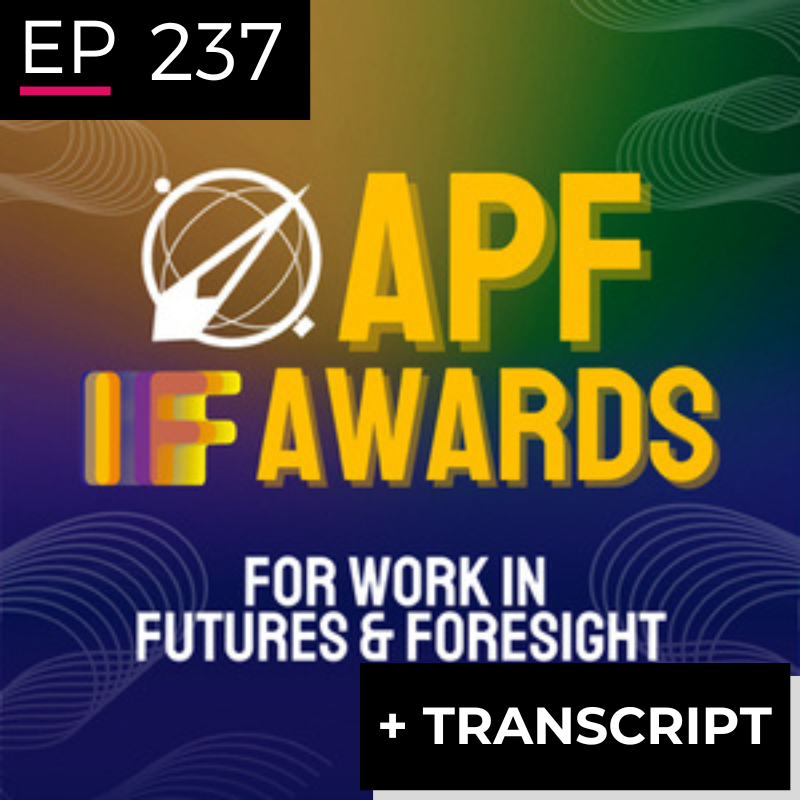
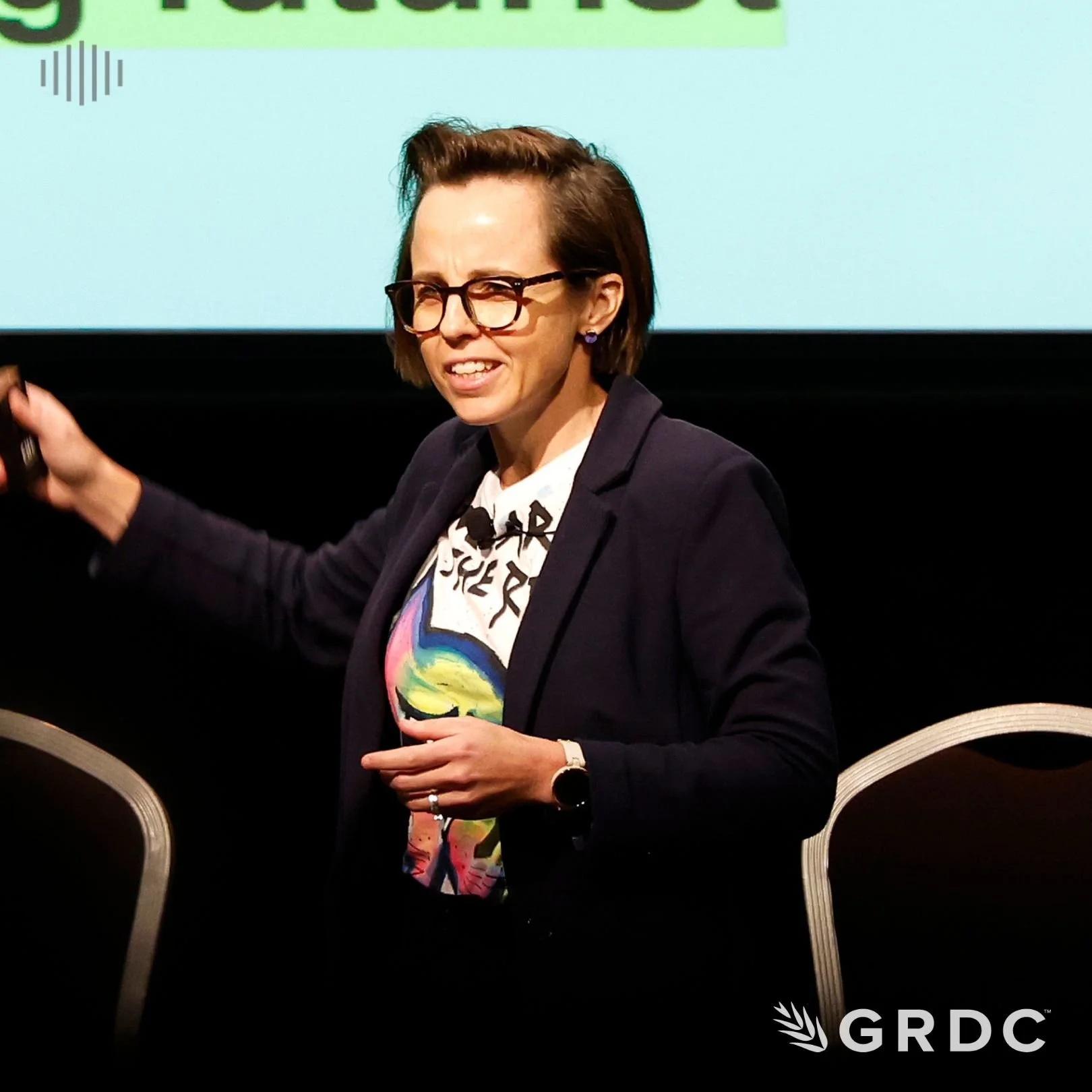
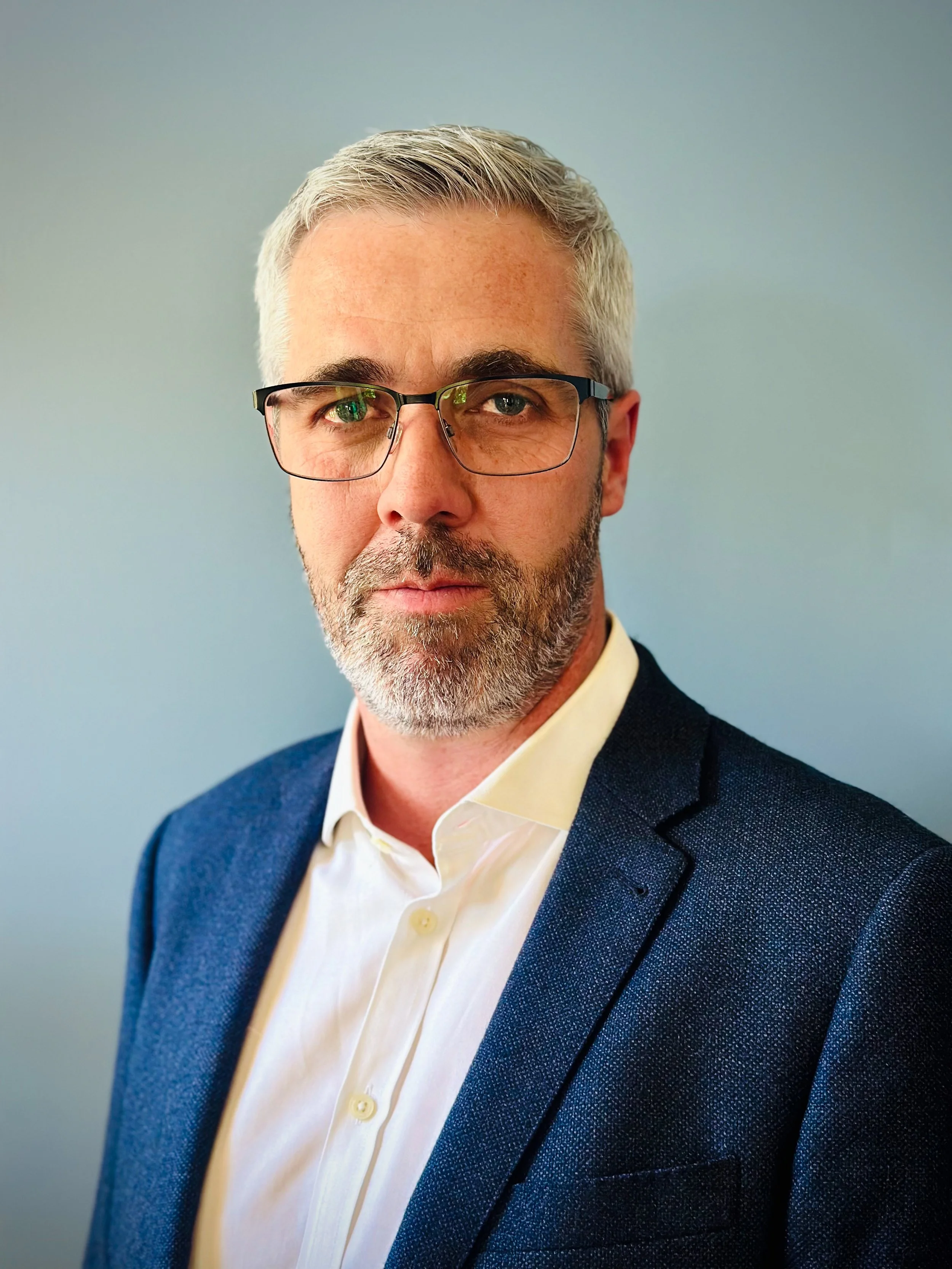
In episode 237 we meet two of the Winners from the Association of Professional Futurists IF awards, Reanna Browne and James Allen.
Interviewed by: Peter Hayward
Transcript
Peter Hayward: Every year the Association of Professional Futurists give us the IF awards that reimagine what makes great foresight work. And today we are going to hear about one of the remarkable winning entries.
What was this piece of work? What did you do that ultimately caused the judges to go, wow.
Reanna Browne: It is hard to answer neatly. I would describe it as an assemblage of things. At the high level, we spoke about this as foresight, as relational infrastructure. So a practice, a process, a whole bunch of things that help people hold tensions around change and enable decisions.
James Allen: One of the ideas that we were both deeply steeped in for some time was this idea of the other systems lens or the complexity lens. There's been a dominant metaphor that we have have run with, particularly in the corporate world for the last a hundred years, and particularly in, in the West. And that's this idea of the world as some sort of machine that there are linear dynamics that you can point to cause and effect.
Peter Hayward: Those are my guests today on FuturePod, Reanna Browne and James Allen along with Lavonne Leong from the APF.
Welcome to Future Pod Lavonne Leong
Lavonne Leong: Thank you so much. I'm really happy to be here.
Peter Hayward: We're here to talk about the IF awards and listeners may not know what the IF awards are. So do you just want to tell the listeners what they are and why we are here today?
Lavonne Leong: Absolutely. So the Association of Professional Futurists has been giving awards for outstanding futures and foresight work since 2007, and these awards were reimagined post pandemic as the APF IF awards, with “what if” being the question at the center of futures and foresight, in response to the ways that the field, and also the APF, were growing and changing. The awards have eight categories. Each category is evaluated by a separate panel of really wonderful, qualified volunteer judges. Briefly these categories are Advancement in the Field, which is for new futures methodologies and tools, pushing the field in new directions; for Practice and Applications, which are for projects that delivered significant outcomes.
There's an award for Systems Approaches. Another for Experiential Futures for participatory approaches. One for foresight that builds bridges between different groups, regions, or organizations. The last two categories are Deep Past/ Deep Futures, for work that promotes long-term or intergenerational thinking, and last but not least, one for Novel Images of the Future that sort of broaden our collective imagination in productive ways.
Peter Hayward: It you must have got some amazing wild pieces of work to review under those categories.
Lavonne Leong: We did. They're amazing. I'm not familiar with all of them. I've just seen the winners of course.
But we were really struck this year by the globalness of the awards. And that was one of our goals: to make it accessible to people who were not native English speakers, to folks from different regions, to folks from the global south or the global majority. And so this year, we received entries from literally all over the world. Even just the winners alone live and work in places in Europe and the Americas as expected, but also there are winners from Egypt, from Kenya, Thailand, India, Pakistan, Nigeria, Indonesia, the UAE, and I think that really reflects the growth and interest in futures in foresight globally. So it really feels like our field is maturing and expanding in some exciting ways.
And the APF awards try to reflect that.
Peter Hayward: Awesome. So we could have a lot of podcasts if we spoke to all the winners. And we did that a couple of years ago, and it was good. But this time we decided rather than just talk to one. We would actually identify one that, or any that won multiple categories, and that was the case.
People actually did win multiple categories.
Lavonne Leong: Yes, definitely. There was a real avalanche of imaginative and excellent and amazing work. But this project that we're about to talk about stood out to multiple panels of independent judges. It won a first place for our Systems Approaches category, and second place in both practical Practice and Applications and Advancement in the Field.
Peter Hayward: Wow.
And can you just share before we bring the guests in, can you share what some of the. Things the judges felt about the work.
Lavonne Leong: Yes, I can. And this is the fun part because I love seeing what the judges say and the pleasure that they took in in evaluating and in finding these wonderful projects.
One of the judges wrote this work “addresses one of the most significant gaps in foresight practice: the exploration of tensions and dilemmas. And hear this ‘addressing a gap’ theme come up again and again in the judge's comments. So someone else wrote that it “ fundamentally reimagines how organizations engage with foresight, shifting from static analysis to living, embedded systems of action.” It “creates a methodological breakthrough that advances the field while delivering immediate strategic impact.” Futurists talk a lot about the gap, but this project actually does something about it. The last one is: “this is a wonderful submission that points toward where futures and foresight needs to head. The approach used by this group employing a living systems model and scaffolding presents the potential for a significant leap in the foresight toolkit.”
Peter Hayward: Wow. So do you wanna welcome in the remarkable team that did this piece of work.
Lavonne Leong: Absolutely. It's my pleasure to to welcome in Reanna Browne and James Allen, who are both in Melbourne, Australia. So, really near to you, Peter.
Peter Hayward: Welcome to Future Pod James for the first time, and welcome back to Future Pod Reanna.
Reanna Browne: My pleasure. Thanks, happy to be here. How was it hearing what the judges thought of your work?
Reanna Browne: I actually felt really emotional. there's one thing to read and I think there's another thing to hear someone read it to you, which was an interesting experience most of the time. And James and I have a shared tendency, I think with this we just beaver away with our own curiosities and do a bunch of things, and half the time I just find it a relief to finish work. It's okay, it's done. Even when people say that was really good work, I still find it's mostly a relief. So hearing the feedback that also matches the experience of people inside the organization. That really matters for me, I think because I often ask the question, what does this work in service of?
So yeah, it was really cool.
James Allen: It just nice to have it seen. I think that I think we got the problem that we were trying to solve, but then I guess to hear that it was seen for what we intended it. It to be I think was really nice, but in somebody else's words, I think just hearing that played back, it's yes.
That's it. That's exactly what we were trying to do. Okay,
Peter Hayward: so let's take the listeners on a bit of a journey. So I'm gonna start you with when this opportunity presented itself, how did that happen and what was it that the group were after?
Reanna Browne: Most things that I do that are interesting tend to start with a story where I'm bored or frustrated by something.
At that point I remember midyear, I was working a lot, doing a lot of solo work. This work can be really lonely. So, the way I tend to end up doing new things or different things is to just start speaking it into existence. So I started to talk to some other friends to say, I really wanna do work with other people more.
What came from, that was a one-off workshop that was a design challenge for me and a couple of other friends to say if we had a HR group, so people and culture group for a whole day what would we do? What would be a rapid, bunch of processes that ranged between futures, complexity, design that had impact, what would we do?
So, it was like we created our own design challenge in a way, and then found a client willing to give it a try. So that was working with Australia's Red Cross Lifeblood their people and culture team led by a brilliant HR leader, and they're an amazing team. So, they were brave enough to say, yes, we'll spend the day with you in a one-off workshop, teaching us some 101 futures. And it was a bit of a one and done, to be honest for a while. And then later they eventually came back to me with a bigger question, and that's how the work happened. It was almost like giving them a light touch version. And then from there they started to ask more questions about how that work could be applied in other settings.
Peter Hayward: I'm interested. What you could have done, but would've still been professional and met their requirements. But as two masterful practitioners, you could have done it, but you chose not to do it. But what could that work have looked like if you had done it, I don't wanna call it conventional, because that kind of is a pejorative, but just simply say, what is the piece of work that you could have done?
Given the client a good outcome, but you chose not to do,
Reanna Browne: I think that experience with the workshop was enough to just get the cogs ticking. So, the client came back to me directly later saying, hey, we are building a new performance system, I think it was, and we want to know whether it's contemporary or not.
And for me that's really interesting for a variety of reasons. One, I often think people care less about the function of the work that we do and more about the dilemma and how might the work actually help us with that.
And so for me, I asked the bigger question 'cause they said to me what are other people doing? How do we know this is a contemporary? I can't remember, it was like a performance system. And then I just said what are the issues for which, us coming in and telling you and doing some research of what other people are doing is the answer.
And that started to tease out things around we want to test the resilience of this idea based on things that are changing around us. We want to see if we've missed anything. Is there any novelty that's emerging in this space? We want to challenge assumptions around the way we think about.
Performance work, people and the future. And we want that to be translated into action. So we could have run a one, one-off workshop around that. We could have given them answers around what others are doing. We could have produced a linear trend report.
And in fact, one of the clients at the time said. Can you do just a trend report, a general one, like the big four? And I said no. And that's immediately when I messaged James to say, our years of frustrations around scanning and I think we use the term James, we want blow up PESTLED I think now's the window.
Picture a project back, and that's where James came into the conversation.
James Allen: Yeah. Yeah. And I think. That one of the sort of drivers for it, I suppose in getting at that question of what could we have done? I mean I've been doing this for some time now inside organizations or for four organizations and the trend report is the staple.
The scenario workshop is something that I'm well familiar with and have done many times over. And I think what. What I came around to was this idea that these artifacts or these processes can sometimes come off as what I've taken to call corporate confectionery in insofar as ev everybody loves it, as in they're interested.
It's tasty. It's stimulating and fun often. But it, the question is whether or not it. It gives them any sort of lasting nutritional value in terms of decision making. How is it actually augmenting decision making? And it wasn't always clear to me that there was a through line from from foresight to a, to insight to a decision and then action.
And so I think that was part of the frustration was how do you, it's been a bit of a obsession for both of us, I think, is how do you make. But how do you make the rubber hit the road? How do you ensure that people aren't just, are like leaving those workshops and those trend reports, gathering dust and going and having the ma making the same decisions that they were always going to make.
And so it was, that was one, one of the drivers was to try and find a way to make it connect and actually change decisions.
Reanna Browne: That shift for me from, I always talk about this idea of how is the work not just interesting, but also important come Monday and that design challenge within that last part I think is a under explored space in futures work that really drives me crazy.
I also have a background in org design development and workforce planning and strategy. So, I'm actually really interested in the, from insight to action, what does that actually look like? But how do we do that based on how we actually really experience change? Not just that in theory or in, abstractions.
Simple question. But it became a maybe unnecessarily large brief for us to then blow up an entire methodology and everything that we've been thinking about.
Peter Hayward: Alright, you're a pair of anarchists. I think you've pretty much established that. So my next question, which is a big one, and I'll let you unpeel the onion as you want to do it. You've got what I call the developmental dilemma. You want to do more. You want there to be more from the process. After the process, you want there to be more capacity, more energy, more skin, more desire, and that's laudable. But at the same time, if you run a process that wants more as an outcome, it has to then also accept that more can go wrong.
And then secondly, how, what did you do and how hard did you push? And how brave were you and how brave was a client? Because you are pushing into a space and using a paying person, you might say, as a willing Guinea pig. But they are still a Guinea pig and you are the professionals, and so you are responsible for what happens when you go into this. So that's one impossible question for you to answer, but go for it.
Reanna Browne: I think the first thing that comes to mind is this is how I always work and it's a very precarious line between - this is a great outcome that we may not have otherwise ever got to.
Versus that's, I've literally had the client say, a client say, before you deliver that, but we actually only asked for that and that's amazing for us. But what did you have to go through to deliver all of that so that this is a perennial practice. question for me, Peter, but I think what I tend to do is really shift t heir scope from a narrow problem statement, and I just keep going back to my own practice question, which is what is this work in service of? Is it in service of a bunch of these dilemmas, if that is the case, here's an assemblage of ways that we can think about that. Also very early on in my career, a quote from Andy Hines talking about the notion of permission futuring.
And I think it comes up in complexity work as well is, meet people where they're at work within the disposition of the system. But then I also come from that world. So, it was also to trust my own instinct of how I make sense of change, what I find interesting. I think there's like a halfway in between that both exist and sometimes I tip over both ways.
James probably does too. I think we have a shared professional dilemma in this question.
James Allen: Yeah I think that, it's quite a provocative kind of a question. I almost wanna reframe it though, because I think that the, any work that I do, I'm invested in the problem that the. The customer, the client the organization is trying to solve.
And for me, stepping into and reinventing this methodology wasn't, was actually an attempt to to deliver on that problem on, on solving that problem. And so it's just, I could use the analogy of if you have someone who comes to you and. And says I wanna, I want to get from A to B, and I'd like you to se sell me a horse.
And you're like, did you know about cars? You could use a car. And of course if you're in the late 18 hundreds, the first question that they're going to ask is what's a car? So you have to meet them exactly where they're at on the. On the nature of the problem, I think you've gotta have some as practitioners with some experience.
I think hopefully we've got some sort of intuitions about what will work, and then the integrity to know. The difference between whether or not this is just a a like a fanciful dabbling that we would like to ex explore or whether or not it is going to meet their solution.
And if we're looking at that car and we're like we know you don't know about that yet, but actually we think it's going to solve your problem. And in way ways that is perhaps. Better than what you anticipated. There, there's an intuition there that I think we both had that, that this could be done better.
And I think that's what we lent on. So it's less about anarchy and more about how do you actually bring more value to the organization in ways that just haven't quite been imagined yet or articulated yet.
Lavonne Leong: I've been thinking about this kind of from, from my perspective across the pond, I've been finding that as organizations evolved from this sort of very hierarchical kind of top down, it used to be that futurists could give them a report. And they could disseminate it and they could say, okay, this is what's gonna happen. And, that didn't always work perfectly, but I think it works even less perfectly now.
And so I saw your project as filling an ever widening gap as a sort of whole systems approach, partly because we're crying out for whole systems approaches.
Reanna Browne: I think there's something interesting that you've just really triggered with me there, Lavonne about, and maybe this is when you get older in your practice and you've been doing this for a long time.
There was a very critical moment many years ago when I think it was Ivana Milojeviç was challenging the profession and saying we need skin in the game. We're taught to just sit outside of the system as if we aren't actually part of the conversation. That the work that we're creating, the worlds that we're enacting, the things that we're supporting people with.
So, I think I've hit a time in my practice where. In one way, Joe Voros would used to always say to me, design the thing, or the program or whatever, that you actually need yourself. What do we need in the times to navigate, what does futures look like in a world that is increasingly, scary, overwhelming people are burnt out, exhausted.
But also, I've just hit a point, maybe as I move into my forties where There's more skin in the game. For me in the conversations like I'm inhabiting these futures of work that organizations are enacting, talking about the things that we aren't talking about are equally as important.
The Anab Jain, those with the least powder shape, the future suffers worse consequences. Clients know when they work with me that we're going t be talking about the shadow conversation. So part of the other driver for me, I think now is almost personal to say. I don't think we're having conversations that based on things that are actually happening, like algorithmic harm, for instance, surveillance, they're uncomfortable.
But now I also just feel a personal, ethical push to say, where does the work allow for that to emerge as well. I don't know where that sits ethically. We are inhabiting these futures, and I believe especially HR, I actually think they're tiny architects in the future of work. So that was a real personal driver for me as well.
And they know that the clients really trust me in that space as well. And I think that's the other part of it.
Peter Hayward: I know that's been a long setup. But now the listeners are dying to know what it was you did so over to you two. What was this piece of work? What did you do that ultimately caused the judges to go, wow.
Reanna Browne: It is hard to answer neatly. I would describe it as an assemblage of things. At the high level, we spoke about this as foresight, as relational infrastructure. So a practice, a process, whatever you might call it, artifacts, a whole bunch of things that help people hold tensions around change and enable decisions. And there was probably, four or five key elements of that I think became quite. Pivotal, and I say assemblage be cause it's a bunch of things that came together that made sense as a coherent set in the end.
But maybe I'll pass to James. You might be able to do a more coherent summary
James Allen: so that Yeah, that's the right word. Assemblage. And I think what was interesting was it was drawing together a bunch of our. Experiences our d our sort of complimentary disciplines to be able to pull together this sort of coherent whole.
One of the things I'd say before I go through the other method is to say what one of the ideas that we were both deeply steeped in for some time was this idea of the other systems lens or the complexity lens. So heavily influenced by people like. Like Dave Snowden nor Nora Bateson Viv Reed Gregory Bateson, those kinds of people who were taking the the systems thinking conversation way forward.
They wouldn't even call it systems thinking anymore to say actually there's been a dominant metaphor that we have. Have have run with, particularly in the corporate world for the last a hundred years, and particularly in, in the West. And that's this idea of the world as some sort of machine that, that there are linear dynamics that you can point to cause and effect.
And I think that the other linear trend report is a one of the manifestations of that kind of thinking. And so we were aware that's useful in, in some contexts, but that there was something that we could do here to be able to further in infuse our foresight practice with complexity thinking.
So being able to look out at the world and say the world is a complex system or a se series of. Of nested complex systems. When we look at the trend landscape, what we are looking at is probably something more akin to if you want to use a, another metaphor, maybe more a forest ecosystem than it is.
Some sort of machine. And so within that ecosystem, there's push and pull tensions continually, it's a complex adaptive system. Ev every reaction begets not just a reaction, but a series of cascading reactions that then push back in in all sorts of unexpected ways. So the idea.
That you can outline a linear trend starts to make less sense in that context when you're viewing the trend landscape that way or any sort of organizational like landscape, the future of work or whatever it is. So that's one of the key ideas that infused this work. And so that meant that.
Our, particularly, I guess the second phase of our methodology, which was the sort of ma mapping out what we've called the trend ecosystem. So being able to map. The coexisting like forces that are affirming whatever is going on in the current state, but also denying whatever's going on in the current state.
But then also reconciling those two those two affirming denying those forces. So they create this constellation of patterns that, start to look more like dilemmas than trends or tensions. So we started to name those. So that was step two. I've jumped a step, but let me come back to it.
The, as a first step re really in the first, innovation. And this is, it's not entirely new, but we just pulled something sideways from a different discipline. So my background, I spent the best part of a decade early in, in my career as a intelligence analyst. And so I've heavily steeped in sort of intelligence analysis, trade craft.
And I know that Joseph Voros, I've heard him say that it's a cousin discipline to, to foresight, and I think he's absolutely right. There's heavy overlap, and I think that there could actually be a lot more mutual learning going on. But one of the things that, that other intelligence analysis does really is this idea of hypothesis generation.
So rather than jumping to analysis. Informing your collection of signals and the way that you guide your efforts to look out at the world with some some hypothesis generations. So what we did was we coupled, we coupled gen AI technology with also an archetype framework using like Ian archetypes or.
A version of that and began to ask ask the question. If we know that the dominant landscape of, so some aspect of the future of work, let's say it's people have historically, and up until now, look, they've leaned heavily on credentials, u university credentials, all that kind of thing.
If that's the dominant state, then we can use this sort of hypothesis generation activity to then go. Through the lens of say a rebel archetype. What are the possible, so let's forget about reality for of the moment. This is pure imagination ideation. What are the possible like manifestations of that archetype, that revolutionary change archetype in the world?
How could that look? What might it look like? From the perspective of a of a trickster archetype, you start to generate a lot of ideas about what signals could be out there co completely detached from reality at that point. But then you move into your scanning and collection of signals phase where you start looking for those things.
And what's really interesting is you find stuff that you. Had you not gone through that process of hypothesis generation, you just would not have looked for, maybe you'd stumble upon them, but oftentimes you, you just think, I just didn't, I didn't even know to look for that. Gen ai. I find, I know that people say, oh, hallucinates, it's in, in of the purpose of this function, that's a feature, not a bug.
So we're like, how do we leverage that? To be able to, broaden our perception about what is possible and then start looking for it, fi find it, and then pull that back into the analysis. So that's the way we generated all of that fodder for affirming, denying, and then reconciling forces.
So that's, yeah, then analysis phase, that complexity lens, trying to consulate those tensions. Then we created a digital artifact. And this was an unexpected one for us. Re, do you wanna talk about this bit?
Reanna Browne: So I think, yeah just to jump on the back of what you were saying, it's, I just keep going back to one of the unconscious drivers in the design of the work was to ask ourselves, yeah, but what do we find interesting or frustrating or what's our actual lived experience of change?
And for me, I always know there are tensions, there are trade-offs. I spent a lot of time looking in the shadows of the, denying forces or what are subcultures talking about? These aren't just random things. These are intuitive design insights, really. And we've started to capture those and I guess put that into an infrastructure and a methodology.
And that combination of both of our mutancy, I think created a really interesting approach to, at the headline, what I would say we were doing was to borrow day Snowden's idea of helping people make sense of change so that they can act. And the second part of what we did was to the insights to action was I think about helping people create a good present.
I always go to Eckhart Tolle's quote of, we create a good future. Essentially by creating a good present. The job is to create a good present. So how does this inform the present? How does it widen perspective, challenge ideas? So, we took a different approach to the sense making essentially both intuitive and drawing on all of our mutancies and backgrounds.
The client essentially arrives at this point, which is to say what were your findings? And writing that in a 200 page report for me has never been an interesting way of exploring what's changing. So I'm really driven by aesthetics. It seems very, superficial, but again, I just trust my own instinct.
Aesthetics are important to the way that I engage with information, so I wanted the artifact that people engage with in these, eight key stories of change. To be something interactive and to be able to literally zoom in and zoom out of those things to be able to contribute. So we had a digital product, essentially like a Miro board, and we hosted it almost like a world with these eight interconnected but distinctly different stories of change that spoke about the tensions that allowed people to share their own signals that captured clips of audio. We held quite a big space on this digital artifact around memes. Because I'm quite obsessed with memes being such a brilliant way of capturing this cultural sentiment immediately of the tensions.
We were talking about what's happened in the past, what's emerging, what's, denying and pushing against that, and where are we seeing different kinds of responses. Alongside that, we also added an audio dimension. And what I've learned is that people engage with that in so many different ways, and it's like how do you design to the edge for that?
Some people literally read the entire thing in one go. Some people said, I just wanted to be absorbed in the thing that was most sticky for me. I work in recruitment and one of the stories was about the broken talent pipeline and the rise of underemployment. And a whole shift that's occurring, or I work in health and wellbeing and story was around the myth of the average healthy worker doesn't exist.
So, what does that mean? So, people were able to engage based on. The proximity to things that were sticky for them, and it became a digital artifact that we refer back to a lot and they've continued to add on. So it allows for that. So that was the engagement of what's going on, what's changing there were conversations around that.
And then the most critical part of our package, or assemblage of things to help people make sense of change so that they can act was around a whole bunch of so what now what conversations? This is that window that I'm really obsessed with. F or me there's a lot of unlearning foresight often exits that process as well.
I think futures work. Great. We've spoken about the change. We could have stopped there and said, we've made it really sticky. You asked for information about what was changing to test the ideas of, their HR programs or whatnot. But I'm interested in that last part.
So there were a bunch of very participatory hands-on workshops that drew on complexity principles. But again, also drew in our own instincts and experiences that of practitioners of what does it actually take to change.This is a group of HR practitioners that aregenerally I would say not specifically this group, overwhelmed, burnt out. Exhausted has way too many things to do. That's the design brief. So drawing on, go to what's sticky. We actually said I want, from all of these stories of change, I want us to call out, five or six of the biggest key dilemmas that we now see relevant to our context.
And we frame them around dilemmas because they're not problems to solve, they're just change dynamics that have trade-offs. Then there was a series of questions of saying so what now? What you know, where is there an adjacent possibility? Where is there room here that we can make moves on? And I really focused intentionally, maybe it's an oversimplification, but again, you meet people where they're at and get, I just, my view is to get people moving through the uncertainty is to say, okay, based on these dilemmas, based on where we think we can make some moves, based on what you've said you want see more of and less of around this particular challenge what within our current work can we tweak?
There's stuff that we're already doing that we could dial up. I'll give you a really practical example of that. Talking about, one of, one element of the change was talking about the myth of the average worker being healthy.
50% of Australians have a chronic illness and you add mental health. So who we think we are recruiting? And y young people and rising mental health. It's not the workforce, which we assumed. So one person in the group put their hand up and said if this is about tweaking current work and we've got rising chronic health and illness, why don't we revive job sharing?
It's often seen as an intervention for moms returning from, maternity leave. Why aren't we positioning that out there as saying, this could be amazing in this context. So immediately the affordances of action like of course we could do that. It's like the next thing, like, why don't we just make the taco bottom flat instead of it trying to hold it up?
But then the other space was to say there are gaps here and there are new or different things that we want to be doing. People don't do new or different things. I know this in my own personal life. If you want to do something new or different, it takes a hell of a lot of energy. You have to disrupt your own habitual challenges and inside an organization you might not even be incentivized to do that.
So we spoke about the idea of a set of small bets in a longer game. In Dave Snowden's language is like a safe to try experiment. And the only thing we have to do is to do the thing to learn more about the thing. What that gave then was movement into dilemmas that they never would've touched.
I'm talking like surveillance. I'm talking AI and implications of AI. We're talking new ways of thinking about burnout, like totally new conversationsbut the job was to just allow the movement and to just do the next thing, and then all of a sudden they end up somewhere else and they've got a whole bunch of programs and interventions that one didn't sit inside any traditional budget processes.
It wasn't a special, whole process that it, it was amazing to watch their head of HR just to say, yep, we'll fund those small bets. Go. I was like, oh, there's something really interesting. Like it did not go through any of the drudgery of bureaucracy. It was like, we can move on those things. It's obvious.
Let's just go. And then that from there creates a whole bunch of other things that they've delivered because the job is just to do the next thing again. Last thing I'd say is that's a process and an approach to the work that has helped me in my own personal life. Which is, the more uncertain I am about something, the more I'm now force myself to just move, just do the next thing.
I can't read or research about all of the things and the right possible thing. You have to act your way through the uncertainty. So what is the stealth infrastructure that allows that? And the, some of the best feedback I can get when people say to me, oh, that seems obvious, that's easy. We can do that.
It's cool we're now talking about conversations we never would've touched in this world, but it seems obvious and adjacent to where we are and I think that's really important.
James Allen: There's a quote that I think that Snowden actually pulls from the a Disney film like frozen two.
Anna of. Of Aaronel Anna of Aaron De the Princess. Ha comes out with this song, and it's all about do the next Right thing. And if you actually look at that film, you can see it's like he was an advisor on that film. There's a lot of complexity principles there of do the next right thing.
What is the, what is the system you're actually in? What's the reality you're actually in? And then without being able to see. Necessarily what your five year roadmap is. And I think that's the temptation at the end of these processes is right, we've got foresight, we've got insight.
We'll make a strategy in a five year roadmap. And of course, you're not gonna commit to those new things because there, you know that's new territory and it's uncertain. But all of a sudden, if you flip that, and that's the power of that question that, that. That Reanna always asks, what would you do come Monday?
That small bet all of a sudden becomes super powerful and allows, gives people agency, which I think is another core part of both of our practices, like agency. How are you supporting agency? Yeah.
Lavonne Leong: One thing that's really struck me about this conversation is, how connected, and of course it, it seems obvious in retrospect, but how connected the importance of having these shadow conversations is. And I think as the world gets scarier, the shadow gets bigger, right?
That the stuff that you can't talk about, the outcomes that you can't talk about, and yet maybe will happen in a year or two. It's not 10 years down the road anymore. So the importance of having those conversations is rising. And at the same time, I love how you address those with the smallness, right?
Doing the small bit, and making things safe. And I think that's been an increasing conversation that I've heard among futurists and foresight circles is how important it is to create that container of, safety and how difficult. But the way that you're talking about it, it can also be quite simple.
Reanna Browne: That's love's back to design the practice that you need. Peter knows this and it's not a secret. I think as I was moving through my master's many years ago, I practically had a nervous breakdown and for me it was such the, a massive realization of a how does change actually happen? B, what happens when?
What happens to your sense of possibility when you are distressed in the present? And our ability to be curious about the world, or even curious about adjacent possibilities is distinctly tied to your capacity to be semi regulated in the prison. The other component to that is to say the biggest realization was even though my present felt so big and enormous, it was actually an accumulation of small interventions that meant I ended up somewhere else.
And that's almost, in a way, it's happens to align to a lot of complexity principles, which I was like, oh great beccause that makes so much intuitive sense to me. But it's also. How I've tried to and James and I both shaped the work and its practice. So the power of smallness. Through that process of when I was really unwell, I would say change was happening in quarter second moments, did I decide to do that tiny thing or that tiny thing, and I've only got a quarter to second to decide that.
And the tiny thing may have been to get up, put music on, but the accumulative effect of that it was such a lived experience of, what does it mean to make sense of change and act from a distressed present. And I wouldn't say the work is overt in holding space for, somatic practices, but, and the way in which it is shaped, it absolutely allows people to end up there with, a regulation they're regulated in a way where it's like, of course we can talk about auditing algorithmic management practices. It's what can we, that would've been big and enormous and scary, but for some reason we end up there. So that's really important.
Thank you.
Lavonne Leong: Thank you. I'd also love to hear if there's time where you see taking this work next, who would be some dream clients or some dream sectors or, how could you apply this further if everyone in the world wanted to work with you?
James Allen: Wow. Okay. Look, I think that because it was I guess it was new for us. I think it's talking of like nervous system overwhelm. I mean it, creating something new is cognitively highly demanding. And so I think one of the things I think, I think we have to, this is another complexity principle.
It's like in kind of any ecosystem, you have to switch between kind of a mode of. Exploration and looking for novelty and creating novelty and then what, is probably poorly termed exploitation. But it's just to say how do you then take what you have learned that's novel and embed that, refine it, and then continue to use it in a systematic way, which is helpful for as long as it is helpful because you're context will change, obviously. So I think that's part of the next phase is to be able to take that work and distil it a bit more to un understand what was the highest value, what was the stuff that we really need to keep in there. And then I think it's going to be a learning journey for us to understand better how to.
How to deploy it too, like not wanting to be a complexity purist about it but I know that we both, as we went through the process, it's like there are a bunch of other things that were on the table for us to do to make it pull closer to that systemic lens that I think I'd like to come back to as well and understand better is it still feels.
It still feels a lot like and I think a lot of this is necessary too. 'cause you have to meet the system where it's at, but you have to adapt it and pull away parts, which are maybe too abstract and too difficult to either execute or for a client to bit.
Be able to digest. So then, there, there's a few compromises you've gotta make along the way. Coming back to that and understanding a little more about what can be re reinjected into the process, but goodness, in terms of who to work with. Any ideas re
Reanna Browne: For me, it's just really confirmed a couple of things.
One of trust your own instinct as a human. I asked this question, how do I move through the future as the future moves through me? And how does that show up in my practice? And for years, I think I held space of like the perfect practicing of this work. And intuitively there was parts of me that was like, oh, it just, it's, it's too much on the periphery.
Learning to lean on that a lot more, I think has been really important.. Again, I just keep going back to what is this work in service of, make helping make sense so we can act, how do we shape good presence? And that's not to reduce ambition. That's because I've now learned that's how you shape, that's it comes from the present.
It comes from creating the safety in a conversation where the next moves becomeexpanded, how can we challenge what's possible, but obvious and easy to do. The other thing I'd say too is the work doesn't have to be as big as that. From that one day workshop I ran like a year prior to our program of work.
That contributed to, and they only contacted me after to say, hey, we've won this big award around women's health and Menopause program at work. Because on the back of that workshop, we just had an epiphany of saying, we've got a lot of women in our workforce. You are talking about all of these,
I always talk about the future ofwork in the context through health, a very under-discussed conversation. And it just the next move just seemed very obvious and easy for them. And so they just did it. So work doesn't always have to be big. I think that's really important too because people assume bigness is big outcomes.
That was more of an ongoing piece. I would say. We made it big because we decided to blow up our whole process. But from here, I imagine we work with clients and saying, we've got inputs now. We will forever tinker with the way that we do things because it's a superpower and a kryptonite that we both share. I get to the edge of something and so does James, I suspect, and we just want to blow it up.
So we just have to navigate around the fatigue of doing that, but. From now on, it's, I think it's really at that macro level, taking all of those learnings and the inputs and thinking about that and meeting the client where they're at. For some people it's we've got a day. For some people it's, we've got a day that turned into an ongoing partnership.
So for me it comes back to lastly, just, how does this work actually? Help us shape futures that we actually want to inhabit. Maybe I'm less more overt in sharing some of the advocacy part and really trying to rise that in others both in and outside organizationsbecause we are all inhabiting. I say that to hr, it's like the things that you do in your tiny decisions, even the boring ones, shapes the future of work that you are going be inhabiting. Is that actually what you want? And I think now's the time for that as well. But helping people do something with that is the other part.
James Allen: That's beautiful. Re can I add one thing and it's that what I'd love to see as an extension of this work, this is not just us, obviously this is a whole of profession, whole of world. Endeavor. And it's that sort of dispositional shift that I'd like to see from that kind of five year plan for everything to one which is getting more at what.
What re was talking about with what you do come Monday looking for, may maybe it's a pat tip to to real Miller who's probably one of the few sort of higher profile practitioners who I've seen start to bring in complexity. And it's probably what he means when he's talking about the difference between using the future.
For e emergence or for essentially control, which I think that lure of that five year plan and that kind of thing is that is the latter, is where that emergency is a dispositional. Shift where you are like, okay, it's foggy and it will be perpetually foggy. What's the dispositional change that we need to be able to do the Anna or Elle thing?
Just take that approach of what's the next, what's the next right thing? What
Peter Hayward: I'm gonna bring this down and land it. I'll start with Lavonne Thank you. APF for having the IF awards, having the courage to bring that in, replace an already existing award system, which something that I think is better for us where we are. So congratulations to you then. Yeah they are working well.
Lavonne Leong: Thank you so much. It's really wonderful to hear that feedback.
Peter Hayward: Take that back to all the people involved in APF and look forward to next year and to Reanna and James, congratulations for being multiple winners. Congratulations for your courage, for your openness, for your generosity and for your intelligence and humility to talk about such remarkable work. And thanks for coming onto the pod and allowing us all to share it.
Reanna Browne: My absolute pleasure. And I just second the thanks to the APF yeah, amazing. I think the acknowledgement by peers. Based on work I'm actually doing on the ground was really powerful.
And yeah, just amazing work. I know a lot of that, if not all, is voluntary and that takes a lot of energy in the world that we're in. Yeah. As a fellow practitioner, hugely appreciative. We're also happy to chat to other people. James and I nerd out about this stuff all the time, so maybe get us out of our our digital basement chats and to share those insights.
James Allen: Maybe we need a wider signal chat, Re.
Reanna Browne: True.
James Allen: Bring in the fold. Thanks folks. Echo all those sentiments. Thank you. Thanks to the APF and for the conversation. Such a lovely conversation. Thank you, Peter. Thanks Lavonne.
Peter Hayward: Such great work. Congratulations again to Reanna and James. And thanks again to Lavonne and the APF. Future Pod is a not-for-profit venture. We exist through the generosity of our supporters. If you would like to support the pod, then please check out the Patreon link on our website. I'm Peter Hayward. Thanks for joining me today. Till next time.