

In episode 236 Elissa Farrow returns to the Pod, and brings some friends, to talk about the second iteration of the Oceania Futures and Foresight Symposium on the 26th and 27th of March 2026.
Interviewed by: Peter Hayward
Links
Past episode: EP 210: Oceania Futures and Foresight Symposium - Elissa Farrow & Jeanne Hoffman — FuturePod
Audio Transcript
Peter Hayward: The Oceania Futures and Foresight Symposium is returning to Australia in 2026. So what can we expect ?
Elissa Farrow: I feel the word that describes this symposium is blessed. I really believe that we're building on from last year 2025 symposium is this broadening the voices, amplifying those voices where they're often not heard, in particular focusing around themes of considering equity. The offers coming through our speakers around cultural ways of meaning making that they are beautifully and honorably sharing with a broader audience is something that's very powerful for me. We actually start our symposium with that deep grounding and respect for the fact that even where we're located is the land of the Yuggera and Turbal people. And, it's incredible to be by nature. So we'd listened to participants from last year in the many positive reflections, but people said we want to be a little closer to nature. The venue is fantastic for that, being on the banks of the river. And I'm really looking forward to just seeing people spill out at lunch onto the banks or just sitting on the deck, having lunch and looking at the beautiful big trees Peter Hayward: Welcome back to Future Pod Elissa.
Elissa Farrow: Thank you, Peter. Lovely to be here with you again. And I've brought some friends this time.
Peter Hayward: You have. Last time we spoke was when you were organising the first symposium, which happened, and it's happening again. How did you feel about the first one and then introduce your three friends?
Elissa Farrow: Yes, certainly. The very first Oceania Futures and Foresight Symposium where Dr. Jeanne Hoffman and I had this idea over a coffee one day manifested into a beautiful two day process in Meanjin, Brisbane in April, 2025.
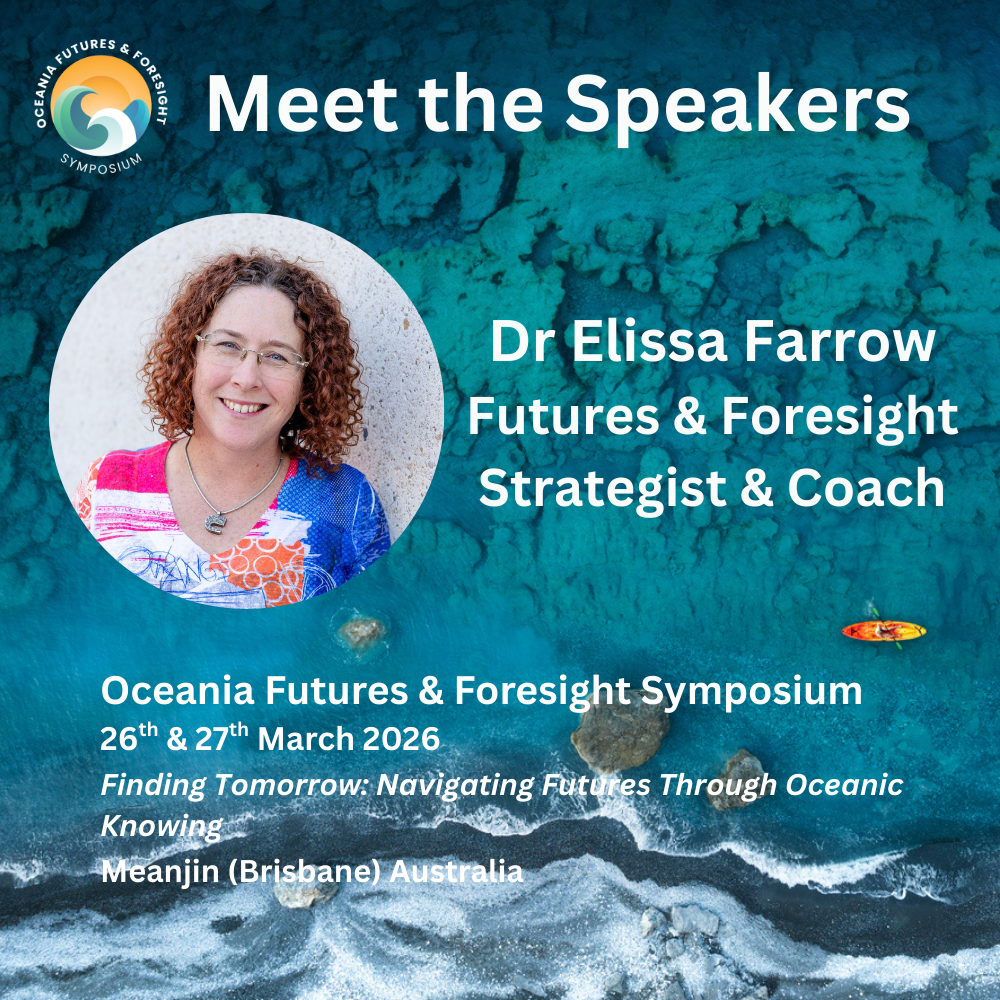
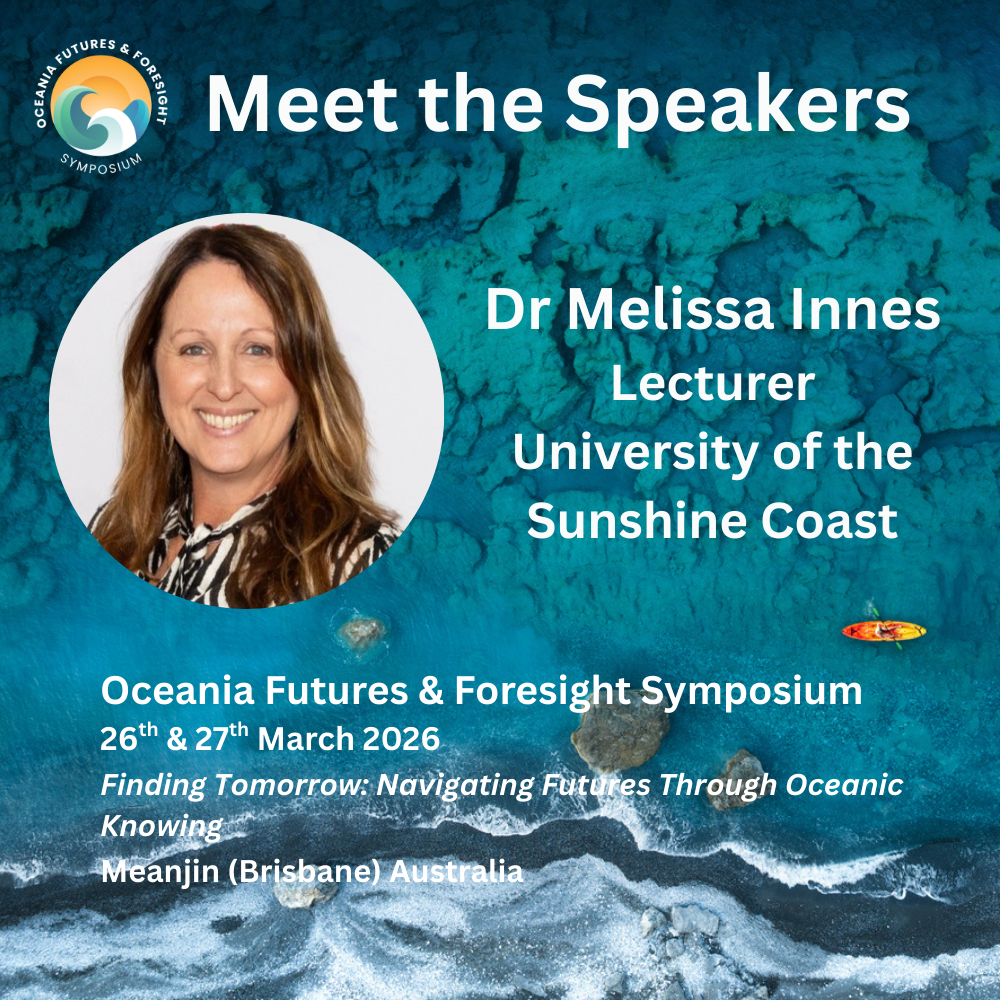
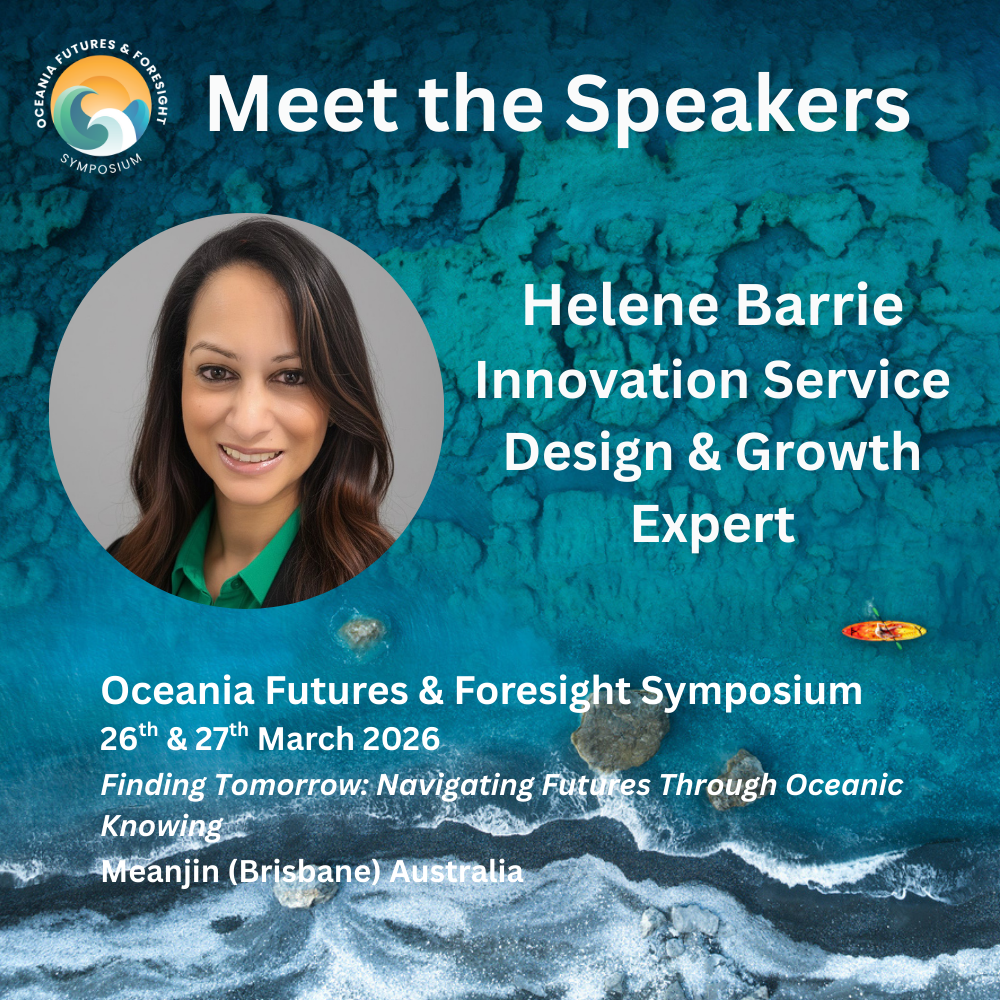
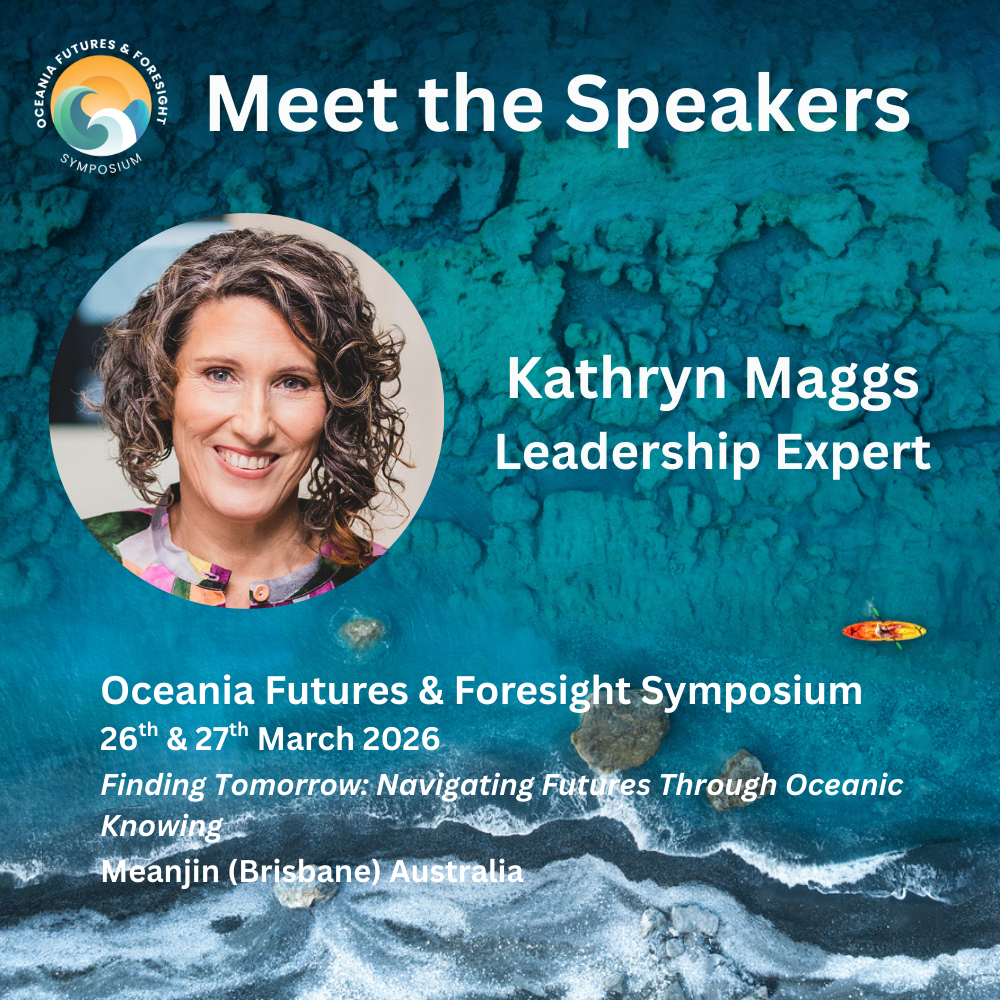
And I felt it was a warm collegiate community feel; it was offerings from people from across the region sharing their tools, prototyping, piloting, dancing, moving through the process. So, I really felt I wanted to volunteer my time and host another and put the call out. And these three lovely women working with me answered that call. Two people that came to the first symposium, so Helene Barrie, and also of course we have our beautiful KathrynMaggs as well who attended. And a new friend who Dr. Marcus Bussey introduced me to from the University of the Sunshine Coast ; Dr. Melissa Innes. And so the four of us have called ourselves the co-curators of the event that's happening on the 26th and 27th of March in a few - it feels like - a couple of months’ time.
Seeking Tomorrow, Navigating Futures Through Oceanic Knowing is the theme that builds on the 2025 symposium.
Peter Hayward: Awesome. Let's invite in your guests so let's start with Melissa.
Welcome to Future Pod.
Melissa Innes: Thank you very much, Peter. It's wonderful to be here today and be joined by my inspiring colleagues in this futures area.
Peter Hayward: So your background, your connection to futures and foresight.
Melissa Innes: Peter, I recently met Elissa which was a very fulfilling experience through Marcus Bussey, my colleague here at University of the Sunshine Coast and Marcus and I had a very interesting chat about my PhD research, which was all around individual foresight and how individuals position themselves in this broader world, and the many contexts that we find ourselves, in terms of trying to navigate what we might like to position as a successful or pleasurable future moving forward.
Peter Hayward: You are going to talk to the listeners about the key themes that are going to be in this symposium. So what are they?
Melissa Innes: Yes. So how do you put together a symposium of incredibly diverse speakers who are facing this really opportunistic moment of considering futures?
Everybody comes at futures with a very different perspective, and it's just so incredible to consider what that looks like. We decided that the most important thing is to position that knowledge in terms of where it has come from. And so our very first panel when people arrive, is going to be about meaning-making from our ancestors.
And this wisdom comes from of course, the Oceania region. And I wondered whether your listeners might be curious about what the Oceania region is first, because the name of our symposium is Oceania Futures and Foresight Symposium. And I thought I might just briefly mention that encompasses, that region encompasses not only Australia and New Zealand who are some of the larger continents there, but also thousands of islands across the central and South Pacific, including the Melanesia, so New Guinea to Fiji, Papua New Guinea, Solomon Islands, new Caledonia the Micronesia Islands and Polynesia. So even as far through to the Cook Islands. And really that first session is about drawing on the rich cultural wisdoms from a very diverse representation of speakers across those regions.
Peter Hayward: That sounds awesome. We tend to host things in Australia, but we can often forget that we're in a very large spread culturally rich neighbourhood.
Melissa Innes: We certainly are. And when you start to look at the knowledge that pours out of our speakers and the lives that they've lived and then the way in which they've formed that knowledge through obviously a lot of research and connection to our past and our past ancestors and the cultures that have formed that knowledge is really quite remarkable. And it has been a challenge of course and a very wonderful challenge to be able to put the program together based on all of that diverse knowledge.
After that beginning session, we move straight into a session that embraces that diversity and explores variance of different approaches to foresight when we do consider futures. And I thought maybe a couple of examples might help your listeners here, how exciting that will be. So for example, we have Dr.Michael McAllum and Huw Jones joining us, and they're going to encourage reflections around way finding in post normal times. They focus on Polynesian concepts particularly the concept of Kaitiakitanga, which is about stewardship and guardianship, and the role of Kaitiaki as guardians. So really, we find ourselves in this chaotic world of change and uncertainty, sometimes contradiction - and they're going to encourage people to think about time, space, and form through reflecting and understanding how the concept of Kaitiakitanga could help with our own wayfinding journey. So that's a very rich start to looking at the many different ways that we can consider how foresight plays a role in understanding our futures.
Peter Hayward: And after that, what, where do we go?
Melissa Innes: Others in that session are going to explore, for example and this is quite a dramatic difference, the role of cybernetics and visual arts to support imagining and how we act towards a hopeful future. We also are going to be looking at examining the embeddedness of indigenous ways of knowing.
From Te Korekoreka the Maori framework, looking at future making, using traditional knowledge to guide personal and collective transformations. So, bringing this vast cultural knowledge back selves as individuals and how we can look at how we can help build a better future through that ancestral wisdom is where that session will take us.
But again, through very different diverse futures thinking and opportunities and strategies.
Peter Hayward: Yeah, I like how you're juxtaposing many different ways of talking about how we might learn about or emerge into - for people who come along, it's not gonna be of one flavor or one page of the song sheet, so to speak.
Melissa Innes: No, definitely not. Peter, and another example of that is that we have Dr. Liz Znidersic joining us who's a scientist who researches wetland bird species, and she's going to focus - through her work on eco-acoustics on how we can learn from nature and natural systems to inform a sustainable future, in terms of how we manage our environment and operate in that environment.
So again, that really diverse set of knowledge that comes together to consider futures.
Peter Hayward: Great. I think that's enough to give listeners at least a taste of the way we are theming and there'll obviously be the website and people can find more information. But is there anything else you wanna say around the general theming of the symposium?
Melissa Innes: Yeah, I think, all of that information we've just discussed is actually just day one which is quite remarkable because day one, the key theme is about learning from our ancestors. So it's really that foundational, where does our knowledge come from? this collective wisdom - and then day two really starts to put that into practice and show us strategies and ways forward. So day two begins with this beautiful reflective walk actually which my colleague Kathryn, who's joining us today - is going to facilitate and it's called Maiwar, which is the indigenous term for the Brisbane River meaning brown snake. So that brown snake - that Brisbane river Maiwar weaves its way around our venue for this symposium. And so that's going to be a beautiful way to start that day with that reflection. And then we move very quickly once we've come back from that beautiful walk into a diverse panel which talks about the future of humans and technology and what that intersection looks like - and the role of humans in that. And then of course, there's so many sessions that follow that - explore that in greater detail and opportunity.
Peter Hayward: Awesome. And I'm just gonna put you on the spot. Is there one session that you are gonna be at with bells on?
Melissa Innes: Oh gosh. Yes, I I'm definitely going to be at the panel because I'm going to be moderating that panel.
I do have a very great interest through my own research of positioning humans in a very vital way as to how we navigate this increasing impact of technology on our lives, our future lives. So that is of great interest to me, and I'm going to really look forward to what our panelists bring to that session.
Peter Hayward: Awesome. Thanks for your help. So next in is Helene and welcome to Future Pod.
Helene Barrie: Thank you Peter. So I'm Helene and I work across service design, technology, innovation, and futures.
I'm one of the co-curators of the Oceania Futures and Foresight Symposium. And I came into futures practice, through curiosity. I'm passionate about how futures thinking can help organisations and communities to navigate complexity and change.
Peter Hayward: let's talk about the attendee experience. What can people who come expect?
Helene Barrie: Sure. So I'll just rewind a little bit, Peter. My journey into the first symposium, it actually started in December, 2024 when I did a Futures Masterclass with Sohail Inayatullah and Ivana Milojevic. It was curated by Jeanne Hoffman and Dr. Elissa Farrow, and that was my first real exposure into futures thinking and the Six Pillars approach. Jeanne and Elissa both mentioned attending the first Oceania Symposium in 2025 as a way to keep learning and connect with people, and actually work in this space. So futures was completely new to me at the time, Peter, so I went along on my own, not really knowing what to expect, just showing up with curiosity.
Peter Hayward: It's very brave going to a conference where you don't know anyone. Yes.
Helene Barrie: Yeah, and honestly, what I walked into was nothing like a normal conference. From the moment I arrived it felt really easy and grounded. People weren't trying to impress each other or perform expertise. They were genuinely interested in exploring ideas together.
So you know how some conferences feel like hard work, like you are making all that small talk, you're trying to break into conversations. This wasn't like that at all. It felt more like turning up at a friend's place and suddenly meeting all their friends. Those conversations just happened so naturally.
What struck me was also the mix of people. You have people coming from public and private sector, non-for-profits, small business owners, consultants, creatives, researchers, all kinds of backgrounds, and futures was the common thread. Even though everyone bought different perspectives - the program had great balance.
There was hands-on sessions where you could actually try things out, quieter moments to reflect or listen to panels and creative spaces where people explored ideas in different ways. Some of the best learning honestly happened between sessions, either over coffee or in casual conversations, and they were just so rich with insight.
No two sessions actually felt the same. There was always something you could take away personally as well as professionally, and if you missed anything, Jeanne and Elissa published a playbook afterwards, which was a great way to reflect on the two days and catch up on sessions I couldn't attend. In the end I didn't just leave with new ideas. I left with real connections, new ways of thinking about my work. And the confidence to start applying futures in practice. So it's actually what led me to put my hand up to co-curate the 26 Symposium with an amazing futures team. And that really says it all, Peter.
It's the kind of experience that stays with you and quietly changes how you see the world.
Peter Hayward: That sounds amazing. So given you had such a powerful experience, the temptation is to run the same thing back again, saying, let's do it again. Is that what you've done or are you trying to deepen the participant experience even more?
Helene Barrie: I think it's a combination of bringing through what worked really well and creating that experience where you are. It's as if you are walking into a family home and meeting all your friends again, so bringing that experience to life again. Creating that safe shared space for conversations to flow - for that connection to happen between people - to leave that symposium and want to do more and make more changes and connect with people they might not have connected to previously.
Build new connections as well. And it's a really nice space for people to put these things into practice. It definitely does build in terms of the themes, as you heard from Melissa - from the last one. So there's more to look forward to. It's always very hard when you go to a session - you want to join every single session.
So I highly recommend reading the guide, the program and being really deliberate with what you would like to attend and be part of on those two days 'cause it'll be amazing,
Peter Hayward: I wonder whether there's any way that people who are coming like you, not knowing anybody, can they find people who can at least guide them or coach them as to where they go and how they do things?.
Helene Barrie: Absolutely. because that was my initial experience. Everyone there is always willing to help.
So it's just a matter of going in open with curiosity to learn and to have confidence to just ask questions and stay in contact. And everyone that's there, that's either on the panel or through who you'll meet will more than likely be happy to stay in touch and be connected and be a source of information.
So that's one of the best moments in the conference - is meeting all those people and learning about who they are and being able to stay in touch and keep working your own individual practice as you go.
Peter Hayward: And what's your session that, of all the things you are definitely gonna be at?
Helene Barrie: Yes. I'm very interested in Dancing in the Ruins of the Future with Dr. Marcus Bussey. It really gets futures out of the head and into the body. And shifts how we sense and understand change. So I'm very interested in doing that. Getting a little bit of movement in the conference as well, because sometimes when you are there and you're sitting for a while, it's really nice to get up and do that and experience it not just from cognitively, but sensing and into your body and how it makes you feel.
Peter Hayward: Yeah, that's, that sounds very much Marcus as I know him. I'm sure he'll do a wonderful job. So again, thank you very much. You've done a fantastic job of painting both the welcoming nature, again, I heard the real enthusiasm that you got from attending.
Helene Barrie: Thank you Peter.
Peter Hayward: And lastly Kathryn welcome to Future Pod
Kathryn Maggs: Thank you for having us. My, my entry into futures and foresight was actually last year's symposium. Something that I, as I greeted all these new people at the event, something I honestly and openly expressed was that I'm a futures virgin.
It was the first time I'd ever been exposed to it, and I echo everything that Helene has said - and I went with a friend who I dragged along with me - 'cause I knew she would love it. And I turned to her and I said, this is like coming home. It was a community. It was like, I felt, I found. My people, my, my family, my tribe.
It was such a welcoming experience. And it was also to Helene's point, the way in which people were so humbly sharing their knowledge - and in a way that they actually, wanted to share it with you so that you could grow and leverage and take away that knowledge and apply it yourself. It was an incredibly beautiful two days - which why I'm here and volunteering on the co-creation team,
Peter Hayward: and you've got the very important conversation around why this matters for Oceania.
Kathryn Maggs: Yeah. As Melissa mentioned, Oceania is such a diverse, and vibrant region, and it also faces some really huge complex challenges though, as well. So not just climate change, but preserving our unique cultures and creating inclusive opportunities. So the symposium's really important because it's bringing together all kinds of perspectives. It's ancestral wisdom, it's the community voices, and also our innovative futures thinking community. And with all of these people combined. It's helping us actually navigate that complexity.
Melissa touched on that day one grounds us in those lessons of our ancestors and reminding us where we came from and what we can learn from that knowledge. And then day two is all about taking that insight and actually turning it into action. So practical steps we can take together to shape the futures that we actually want to see.
Peter Hayward: What do you know of the futures and foresight capability that exists within this vast region?
Kathryn Maggs: It's very diverse and I can only express or share from my experience at last year's symposium - and all of the expressions of interest we've received from an incredible number of speakers across the region for this symposium. When I read their experiences in this area it is very vast and very diverse and that excites me.
Peter Hayward: Yeah, I guess as an Australian, one of the things we have to practice, and I think you all you have represented in this podcast is our ability to listen and learn to not come forward as the group with the answers, but actually come forward as the students looking for the masters.
Kathryn Maggs: Absolutely.
And I might be jumping ahead here, but one of those future trends that we need to be open to and hear about is that collective foresight - because no one person - and no one perspective can predict or solve everything. Our future needs diverse voices, and especially those of our ancestral knowledge holders our community leaders and also our local innovators. So we need to bring, as you say, we need to listen and be open to those perspectives and take that knowledge in a way that we can begin to anticipate those challenges and design solutions together that are culturally grounded and take collective action. So what we're doing here, it's not just a trend, it's not just a two day symposium where we come together, we get inspired, we feel all warm and fuzzy inside, and then walk away.
It's one where we actually - all attendees and all presenters genuinely want to make real change, and we are coming together to listen to each other and share those ideas so that we can take away actions to make change.
Peter Hayward:
And what's your session that you are absolutely gonna be at?
Kathryn Maggs: It's such a hard question to answer because there are so many amazing things that we're going to be experiencing. I think one of them is going to be Ouija futures: Learning to Live with Ghosts. And that just fascinates me because I don't think there's one of us in the room that as a kid did not get out the Ouija board and have a go at trying to speak to the ghosts.
So this one absolutely fascinates me. If nothing else, it's going to help me bring out my inner child and learn how we can live with our ghosts and learn how this can apply to our futures.
Peter Hayward: I'm just going to go back to each of you and I'm going to ask you to give me the one word that you think describes this next symposium and what's a trend or an issue that you are taking into the symposium, hoping to find people to talk about it with. And let's go back to Melissa.
Melissa Innes: Yes, Peter. I would love to do that. I think given my own vast interest in knowledge and the power of knowledge - I think knowledge has to be my word for this symposium. And in terms of thinking about a future trend, I'll come back to - Kathryn talked about collective foresight - and a lot of my work is around the sharing of knowledge and the collective wisdom that can come from sharing the unique knowledge and experience that individuals bring based on their own lives - and obviously through this symposium - the lives that we formed around ancestral knowledge and wisdom. I think that's something that we as a society need to work with. And you talked about listening. I call it reflection. I call it taking time for us to really process and reflect on the opportunities that we have ahead of us and work together to solve problems in that way.
Peter Hayward: Thanks, Helene?
Helene Barrie: So my one word to describe the symposium is immersive, and one future trend that I'm interested in is thinking about the immersive futures experience as well. Because the future of foresight isn't just analysing scenarios, it's experiencing possibilities through embodiment, creativity, and technology - so better decisions can be made today.
Peter Hayward: Thank you. Kathryn?
Kathryn Maggs: Yeah. Again, hard to narrow it down to one word, but thought-provoking. If you come with an open mind and curiosity as Helene's mentioned, you are going to reflect and challenge some of your own perspectives. The future trend definitely is that collective foresight that I mentioned before.
It's the power of those diverse voices that are going to come together and help shape those resilient futures.
Peter Hayward: Elissa?
Elissa Farrow: Oh, thank you. I have just been really loving this conversation.
Peter Hayward: What an amazing team you’ve put together.
Elissa Farrow: Oh yeah. Blessings. All around and that probably would be my word actually.
I feel the word that describes this symposium is a, is blessing or blessed or blissful even would be a word. The trend that I really believe that we're building on from last year 2025 symposium is this broadening the voices. Amplifying those voices where they're often not heard.
In particular focusing around themes of considering equity the offers coming through our speakers around cultural ways of meaning making that they are beautifully and honorably sharing with a broader audience is something that's very powerful for me. Very powerful that we actually start our symposium with that deep grounding and respect for the fact that even where we're located is the land of the Yuggera and Turrbal people.
And, it's incredible to be by nature. So we listened to participants from last year and the many positive reflections, but people said we want to be a little closer to nature. The venue is fantastic for that, being on the banks of the river. And I'm really looking forward to just seeing people spill out at lunch onto the banks, weather permitting, or just sitting on the deck, having lunch and looking at the beautiful big trees that exist.
So that natural immersion which we didn't quite have in our hotel last time, but I'm really looking forward to that. That space. Yeah. Walking there, riding there, catching public transport to the venue just - with people, community building.
Peter Hayward: So exciting. So let's wrap this Elissa. So there are limited numbers of tickets available. This will be a small gathering. So do you want to just run through the logistic situation that listeners need to be aware of?
Elissa Farrow: We never wanted this to be a circus. We wanted it to be a place where that true connection, conversation and family feel - I love that analogy Helene - could happen. This venue is a bit bigger than the limits that we had, but we're wanting to go for around the hundred, a hundred ish. People so that there is time for immersion, time for connection time to almost over the two days meet everyone in some form.
And so we've got an early bird ticket available at the moment and I know that there's a link that will be made available via sticky tickets link. So we've got the early bird right up until the end of. February. And it's a cost recovered model. This isn't a profit making activity.
This comes from the community who are all generously donating their time. Speakers are paying for their attendance that covers delicious catering and the venue hire - which was the model that Jeanne and I had last year - that thankfully worked from a cost recovered process, but we – the holding of space is really important. So if you are seriously thinking of coming, I would get a ticket early. The other important aspect that I'd like to mention is that we don't have formalised sponsorship, but this year the school of Cybernetics from the Australian National University have paid for three concession tickets as a commitment to equity of access. We, in this circumstance, we accepted that kind donation of those three tickets because we believe in the process - but just wanted to give them a call out because that's so generous. And last year people also donated a ticket or two here and there as well so that we could have student attendees who ended up being helpful greeters to add to that warmth and help our artistic processes, for example. So yes, information's on our website.
Peter Hayward: Okay. So just again, when is this happening again?
Elissa Farrow: 26th and 27th of March, 2026 in beautiful Meanjin, Brisbane. The location is at the South's Leagues Club. Beautiful venue by the river in Davies Park.
So yeah, really looking forward to holding space for this event again this year.
Peter Hayward: All that information will be there on our website.
But to each of you, again, my word just listening to you - is joyous, listening to the joy and what you experienced last year, and thank you again on behalf of the community for making the next one even bigger and better. So thank you again for your efforts and thanks for being part of Future Pod.
Thank you, Peter.
Elissa Farrow: Thank you. Thanks for holding this space for us this morning.
Peter Hayward: Thanks to Elissa, Kathryn, Melissia and Helene for getting the next symposium up. And I wish them success. Tickets are scarce for this one so if you think this is your tribe too and you can get to Brisbane at the end of March then grab a ticket now while they are available. Future Pod is a not-for-profit venture. We exist through the generosity of our supporters. If you would like to support the pod, then please check out the Patreon link on our website. I'm Peter Hayward. Thanks for joining me today. Till next time.