
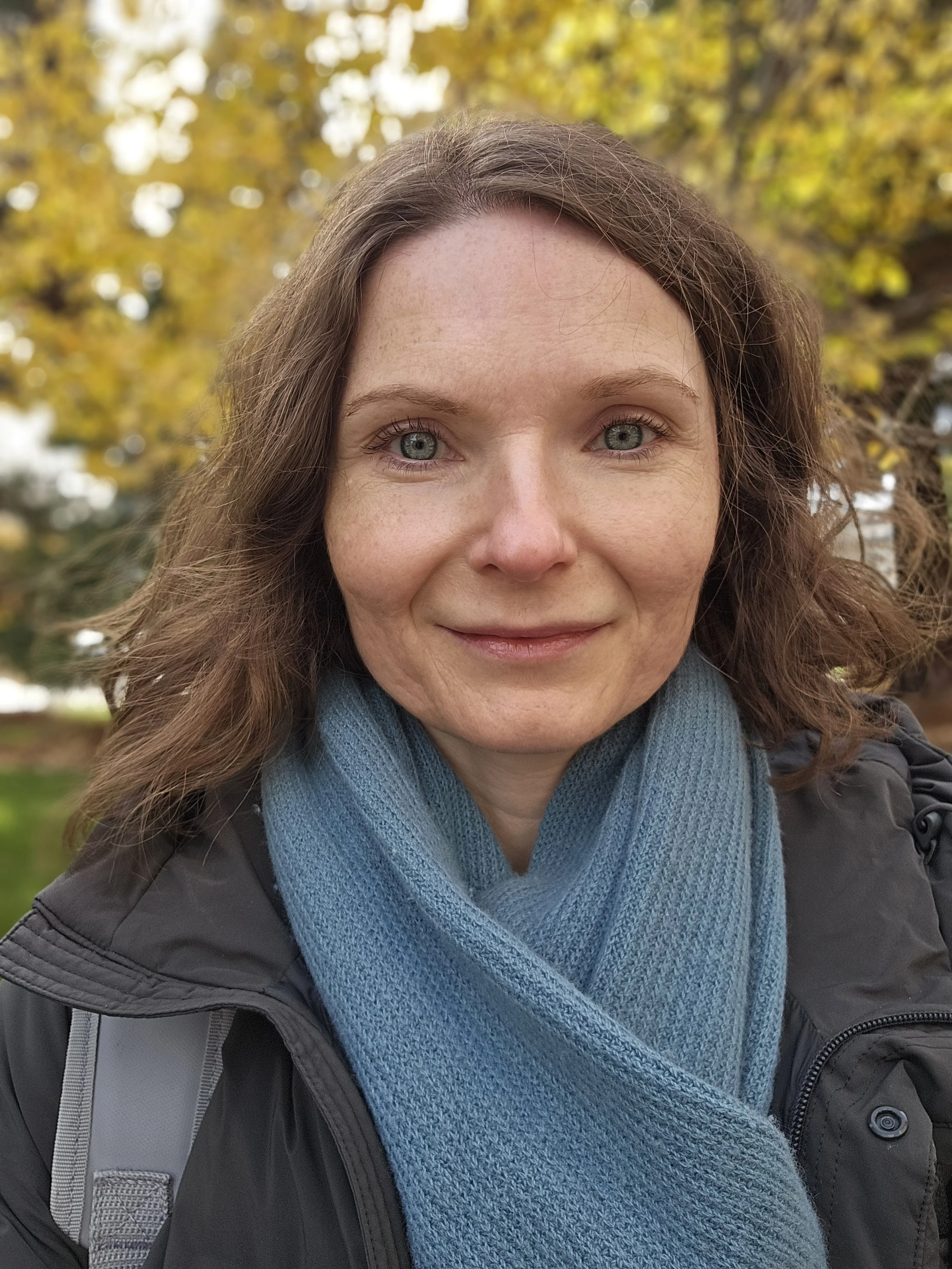
In episode 235 our guest is Dr Ewa Lombard who is a senior researcher the University of Geneva converging the realms of affective sciences and collective intelligence, focusing on sustainable decision-making that withstands the uncertainties of the future.
Interviewed by: Peter Hayward
Links
Compass June 2025 issue on “Strategic Visioning as a Healing Journey for Individuals and Societies
WEF blog article about international decisions
Audio Transcript
Peter Hayward: Can we make good decisions in the circumstances of significant uncertainty? Are there things decison-makers should be doing?
Ewa Lombard: So now we're moving on to what I call the uncertainty spectrum. And the first step where I take people through understanding of neuroscience of decision making under uncertainty is to realize that there are different levels of uncertainty. Some are called risk. We actually have enough data or information that can be expressed in probabilities in which we can apply certain economic or model based statistical methods and then there's irreducible uncertainty scenarios which is level four and level five, the highest level on this spectrum of uncertainty. And in level five, it is futile to try and reduce the uncertainty with data because data will always be insufficient. It's almost comparable to the unknown unknowns. You have to realize that they are there and you might not even be aware which are those. And I think the first thing to understand is that when you realize that the decision poses that level of uncertainty. You have to give up the idea of trying to optimize the decision. So looking for the optimal, the best solution is not what can be done.
Peter Hayward: That is my guest today on FuturePod, Dr Ewa Lombard who is a senior researcher at the University of Geneva converging the realms of affective sciences and collective intelligence, focusing on sustainable decision-making that withstands the uncertainties of the future.
Peter Hayward: Welcome to Future Pod Ewa Lombard.
Ewa Lombard: Hello. Thank you for having me, Peter.
Peter Hayward: It's a pleasure to meet you ever. So thanks for coming onto Future Pod and as we like to start, the first question for guest ever is the story question. So what is your story, Ewa? How did you get involved with the Futures and Foresight community?
Ewa Lombard: Yes, thank you for this question.
It's the first time I get asked. It's quite personal. It almost feels like sitting in a therapist's office. It reminds me of the assignments I give to my students about writing the story of “my future self”. And they get to write at least two essays about their future self in five years from now, and about the more distant ideal future self they want to be one day. We also talk about the ideal self at age 80, and then they don't need to share that. But personally, I am rarely exposed to this question myself! I am happy to have finally found foresight, a community that kind of fits the misfits like myself.
I think looking back now, everything I've done since leaving Poland at the age of 18 fits into being a futurist or a fortnight specialist or having something to do with future thinking. I feel like I’ve always been ahead of my time wherever I went. This is why I left my home country. And then, I wasn't happy with the studies I chose which was economics and management. It wasn't ambitious enough and nobody was asking the big questions about life. And right after the first semester of economics, I was like, “that's it. I'm going to study biochemistry”, and bought myself a book thinking of maybe going back to my home country to study medicine.
But this didn't seem like a long-term viable idea, so I stuck with my studies. After graduating, at first, I was feeling uneducated but then managed to find this fantastic job. I worked at Phillips in the Netherlands, first as a project manager with my double master's degree in management. And again, big disappointment with the corporate field.
Phillips is a fantastic organization. I was in the main seat in the Netherlands. I got plenty of freedom to choose what I want to do, whom I want to meet, and so on. A great moment of learning, but I was disappointed because I just couldn’t be motivated by sales figures and that there's this limitation, on what I can learn or what I can pursue because all those choices had to be somehow related to quarterly targets. So, I found this work too limiting in terms of intellectual freedom. And I started looking out and I found that on the other side of the town there's this big research and innovation campus called High Tech Campus, and this is where they have Phillips Research and it's this giant town of scientist working on all kinds of things. So I asked my very warm hearted and generous boss, if I could go and work there. And he said, “one Phillips!, why not one day per week? With your job at Phillips Medical Systems as a project manager, you can spend one day per week at Phillips Research if somebody accepts”.
So, I found someone who accepted me. I did something like a master's level project on states of consciousness, they called it. But in reality it was about emotional states that lead to relaxation. It was the time when Philips was exploring a lot of things around consumer electronics that made people feel more relaxed.
And coming from the medical imaging division, I was put in a project in which we were trying to reduce people's anxiety while they're waiting or are undergoing a medical imaging procedure. Think big MRI systems or PET CT scanners, things like that. And this was the best work experience I've ever had!
It's just so cool to innovate to be surrounded by other scientists and engineers. We were in this interdisciplinary team, so everybody brought in their own expertise. There was me and two other neuroscientists, and we actually set up an experiment to prove a claim that a certain way of distracting people while they're undergoing a potentially anxiogenic medical procedure can actually distract them and reduce their anxiety.
So this was an awesome experience. Unfortunately I only got to work in the summer and one day per week during the rest of the year because I decided to start my third master's degree which was in cognitive neuroscience. This is where all those experiences come together: The big dream of mine way that I have to go back and study something real, like a real science.
I was so passionate back then. There's this incredible passion when you're 25 and, I would stay up late and wake up at 5:00 AM to read all those research papers, and I failed all my first exams. I had to retake all those exams it was the first time in my life that I failed a written exam.
So this was really painful learning, but I managed the second time. And then I got, I think 9.5 out of 10 on my master thesis in neuroscience carried by this passion that I really want to understand how the brain works and I want to apply this because I've seen how people can apply that in R&D in Philips Research.
And ever since, I’ve been wanting to go back to that kind of work. However, things didn't go according to that scenario, and I decided to come to Switzerland to study emotions. At the time, Geneva was the place where the most advanced study of emotions with FMRI, functional magnetic resonance imaging, took place. I came here and realized that actually, I had been unhappy in the Netherlands, not because of the people climate, but because of the weather.
I just cannot live with 360 grey days per year. It's sad to say, but I left the Netherlands and decided never to come back because of lack of sun. And Geneva on the other hand, has a significant amount of sun. Switzerland is quite sunny. So that was the main reason why I decided to stay here and pursue a PhD in neuroscience studying the process of learning. I've been fascinated with the process of learning. And at that time, my intention was to bring these insights from neuroscience back to education. I was studying specifically the interaction between learning about reward, so rewarding about a certain outcome, a form of reward conditioning, and hippocampal learning. This latter is a form of associative learning, the type of learning that we have to do in school, like remembering certain facts or dates. Surprisingly, I didn't find at all what I was expecting to find. I found the opposite. I found that paying people, associating monetary incentives with information and then asking people to associate that information with some other information is not going to help them learn. It does the opposite because this reward learning component is stronger than the associated learning component which has no reward attached to it.
But I guess the biggest outcome of my PhD was what I learned about myself. Driven by this passion, I forgot everything else in the world. And it drove me to burnout. Towards the end of my PhD, really struggling to finish on time, I felt this impending danger of the fact that my contract is going to end soon and I will be on unemployment benefits and I have no prospect of employment afterwards. I really pushed myself to finish as fast as possible by working incredibly long hours. So at some point with those 70- hour weeks, I started waking up at 4.30 in the morning and I couldn't fall back asleep. And at the beginning I was like, okay that gives me more time to work. Fantastic. And it turned out that it would take me three years to relearn how to sleep through the night without waking up in sweat in this super noradrenalin-driven jolt where you're like, wow, I'm awake. And that is called burnout and it's a very tough experience.
I tried many things to teach myself to sleep again. Eventually what worked was sophrology which is a kind of autogenic training where you teach your body to relax and to go back to a state where you can fall back asleep. And this is where I realized that there are many important things in life that you must prioritize and work cannot be the only one. And ever since, I prioritize my mental health.
So imagine, I did a PhD in neuroscience of memory which is a very complicated domain, and it really took a lot of my brain power to accomplish it. And right after that, I destroyed that brain because I haven't been sleeping for months. So, with my brain reduced to mush I decided to turn to realizing my childhood dream, which was to write a novel. And with all these insights from neuroscience of memory in my mind, I decided to write a hard science-fiction novel about neuroscience of memory.
The novel is titled Project Unison: Mirador de la Memoria. I just loved how it sounds. It's not in Spanish, the whole novel is in English, but I love how the subtitle sounds. I launched a crowdfunding campaign to find a publisher and found a small publisher in the United States. And that's how the novel came to life.
It was a bit of a challenge given to me by a friend, who had been also helping me recover from burnout, and I guess she saw this before me -- that art therapy is actually a very good way to help you come back and reconnect to your old self. So writing was a therapy for me especially since often debut novels are autobiographic.
So in Project Unison, I'm projecting myself into this neuroscientist in the year 2060 or sometimes towards the second half of 21st century where we are capable of actually using technology that you can implant in the brain in order to manipulate our feelings and make us feel better.
And the feeling I was focusing on was loneliness. I think it's still a very relevant feeling. Back then in 2016, a report was published I think by the WHO that showed that loneliness kills more people than obesity and cancer combined. So it was a moment we were talking about the epidemic or pandemic of loneliness before COVID.
And I felt that that was particularly relevant: not only was this feeling relating to my personal situation, but we could also potentially envisage a science-based solution that uses neuroscience to make people feel more connected. So that's what Project Unison is about. It's a suspense novel, obviously, about an experiment where things go wrong. I love these types of novels (hard sci-fi suspense).
At the same time, when you look at the mental process that we go through in experimental science, which is imagining how things could go - that's forming a hypothesis -- and then, controlling for all the things that could go wrong or that could go differently – that’s your alternative hypothesis and your control variables. It's pretty much the same process as in scenario thinking that we engage in foresight.
I would say that based on that science plus science fiction writing experience, I'm pretty well prepared for the imagination of alternative futures that we do in foresight. And writing sci-fi is what many futurists do.
People actually recognized me as a writer. For instance, meeting some alumni my management degree, they’d say “Hey, you wrote a novel!” So there's nothing about, I did a PhD in neuroscience, I wrote an article that was remarkable. But people remembered that I wrote a novel. It's a nice thing to share maybe to your children, with the future generations. I haven't told my son yet. He's three, so he wouldn't understand.
And after that debut novel, I was still working in neuroscience, I did a postdoc in decision making under uncertainty. Which is where I am in again now, after a four year shift, when I was a professor at a business school in France, and there I mostly did behavioral studies, always around decision making. So, the application of memory and reward is very clear to understanding how we do future thinking because the circuitry in the brain for creating memories is the same one that we use for episodic future thinking. Prospection and memory meet in the brain. But I think my work in decision making under uncertainty prepare me even better for foresight and long-term futures. This is what I'm doing now since a year at a fantastic laboratory called LUCID, at the University of Geneva.
I do behavioral studies on decision making, like ethical decision making related to wealth management, and in pro-environmental decisions. That's the research I did while concurrently teaching foresight to business students. The first moment I actually included foresight in my official work was in 2021, when I started teaching a course called Prospective and Future Thinking at Montpellier Business School. And I prepared this course myself: I read some books, followed online courses, the Copenhagen Institute course on strategic foresight. My career didn’t come straight to foresight, but I learned along the way.
And the idea with this course was, it was a workshop. So, we divide the students into groups and they each get a project, the future off X, that then they have to develop with three or four scenarios, and present at the end with recommendations. And I continue doing this, although at a different institution and in a different dimension.
And here is what I bring to foresight: decision making under uncertainty as a topic in my research. We study collective intelligence, specifically collective innovation in hackathons. This is a big project that I've been working on since 2020. And we're also interested in understanding how to engineer teamwork. What are the factors that actually lead to best collective intelligence in teams? But at an individual level, I'm also trying to pick out and apply. So come up with applied knowledge that comes out of psychology and neuroscience of decision making under uncertainty.
And that's a separate strain. That's something I do outside of my university work. Applying that knowledge to real problems, to managerial decisions.
Peter Hayward: Can I speculate on something, which there's a lot of things running around from based on your story, you could almost go back to future shock and Alvin Toffler. But there was a narrative that the world was getting faster, more technology, more fast paced, and we had these evolutionarily developed brains, nervous systems, that change very slowly. They changed across millennia. They didn't change across days and weeks. And as you rightly say, we are now realizing one of our largest sources of illness is mental health.
We're now learning the importance of sleep, not something that's a waste of time, but it's actually a fundamental thing. And memory you are talking about. And of course we also have dementia and Alzheimer's on the other side of memory.
So I, I suppose my speculative question for you is, do you think we have to find ways to enhance our cognitive capacities to better cope with the world we are in? Or do we have to just work with the wet wear that we have, that we are born with?
Ewa Lombard: That's a very interesting question. I am rather on the side of making the best use of what we have.
This is what I try to do for my students. This is what I try to do in my courses. What I try to apply to myself and the first lesson is that there are limits to it and we have to learn how to respect them. The same thing that we're doing to this planet or the system that is called climate. There are limits to the system and we are trying to understand where these limits are.
We're pushing them, but I'm on the side of saying that there are certain, systemic boundaries that we should maybe try to understand how flexible they are. So we're doing a lot of things at the molecular level, right? All of medicine is essentially manipulating our bodies, but we would be better off for the moment just understanding how to best use these bodies.
I still don't think this is well taught in schools. For instance, like what you said about the importance of sleep, the importance of play and curiosity in education, all these things, it's like we're barely just applying it with the discoveries that are fairly fresh. So neuroscience and psychology have sprouted so many new insights, but that's, in the past maybe 50, 60 years.
For cognitive neuroscience, probably even shorter than that. And we still have a long way to go to bring these to people's daily lives, to change work environments, to change schools and education and to change how we make decisions together. So, I am on the side of first trying to understand how can we best utilize the biology that we already have without going against it, for instance, by pushing ourselves to work too much.
That's where you get burnout. Or by doing shift work and working at night that creates a lot of long-term issues. I appreciate people who think about the next frontier. There was a moment a few years ago, I think that was around 2018 when my book was also out, everybody was really big about transhumanism and like augmented cognition.
And I had a few ideas. I included them in my Project Unison book. It was about using stem cells in in the hippocampus to increase our memory capacity or increase at least the speed at which neurogenesis happens in the hippocampus. My answer would be, first let's explore and exploit this most hygienic lifestyle, most brain friendly lifestyle and feel good. Mental health would be my priority. That would already be an augmentation to the world we live in, which shows, very striking statistics about mental health in adolescents and the youth, for instance.
Peter Hayward: I think you mentioned the idea that we can have a collective intelligence, a collective capacity to work and this actually, apart from producing better outcomes, is actually also a more healthy, a more therapeutic way to work. So don't try and do it by yourself, but work with people. Is that the case?
Ewa Lombard: So the definition of collective intelligence is still something that is not super clear in my head, where we're actively trying to understand whether there are some discrepancies in what we call collective intelligence in human studies compared to animal studies, for instance.
But the idea is that a group is more intelligent, meaning it can arrive at a better outcome or faster at an outcome in solving a problem than the best individual in that group. This is essentially the measure. Now what you're looking at is not related to outcomes.
I think what you were appealing to is the fact that we would feel better working in cooperation, working with others, working in teams. So that's definitely true. Obviously there are individual differences. Some people are introverted and it might tire them to be surrounded by people the entire day.
But in general, we are social. We're a social species. We are meant to be collaborating with others and doing things together, and we have all kinds of mechanisms, including language and emotional expression that allows us to synchronize our efforts with others. And there's not a lot of other animals that are so adapted for living or solving problems collectively.
Although just saying that it reminds me of a very funky paper I read at the beginning of this year, which was comparing collective intelligence of humans and ants in trying to transport a very large and weirdly shaped object through a maze. And it was very funny: the researchers actually did videos and several manipulations, and in this manipulation where humans couldn't shout at each other, so they couldn't use their language or their facial expression to communicate how to coordinate, they actually fared much worse than ants. So there are some limits to how we're supposed to be using our skills, social skills for coordinating our efforts with others.
But overall, we work very well when we are together. Although again, there are limits to the factors that facilitate that coordination and cooperation. And there are limits to the size of the group that is still manageable and when it still makes sense to use collective intelligence compared to just having a few experts working at the same problem individualy.
Peter Hayward: Yeah, you're fully aware that post COVID the impact on young people. Missing out on those school years for the one or two years, it does seem as though it's had a quite dramatic impact on the mental health of young people where they were effectively stopped from socially mixing with people.
Ewa Lombard: Here’s what I've observed, and this doesn't come from studies. I know that nowadays we still have a concern around psychological distress. For instance, I think it was 47% of the young people surveyed in Switzerland who reported psychological distress.
But it could be due to many things. It could be, I feel stressed going to school because the workload is very high, or I feel lonely because my friends live far away and I don't know how to talk to them. What we've observed firsthand as teachers, and I exchange on this with my colleagues back at Montpellier Business School and also here at the university, is that we see a decline in social skills.
So this ability to go to get together in a group, debate and come up in with a solution, and I'm not going to tell you how to do that because it's a learning experience, that ability seems to have deteriorated. We see more and more groups where somebody is left out or intentionally left out, or somebody who sabotages the efforts of the full group or even in small groups.
This was not the case when I was a student, that somebody would dare to free ride on the others. Unless the group was so big that, you could justify not doing anything 'cause nobody would notice. So, we see more and more of such behaviors and yeah, the idea is that indeed they missed on this sensitive period when they could have been learning together and learning how to work on a project together. Just how to talk to each other, how to resolve conflict. 'cause a lot of teamwork is about conflict resolution. Let's be honest. And they didn't have this chance. And now it feels awkward to try and, maybe socialize or it's just more difficult now for them to bridge that gap and bond.
I have a few ideas for what to do with it. And I think it's temporary. I really hope this is temporary. And the students that went through COVID will eventually learn how to be with others and they will understand that smartphones are not the way to binding with others to create meaningful relation.
And I hope because all the teachers notice this as well, they're probably also doing something to facilitate formation of friendship, essentially the rediscovery of friendship. I have a feeling that a lot of young people posting about these weird challenges on Instagram, they're reinventing what used to be under the umbrella of “Fooling around with friends”. And nowadays you need a special name maybe because it's just not natural to them anymore. Anyway, I haven't studied this systemically, just from my own observation. And the solution is that they need more exposure.
Maybe they need a little bit more guidance. The principal investigator in my laboratory used to teach team management, and this was a master's level course for finance and for management students, and it was super well received. So, there's a need for teaching people how to work with others. Teaching them how to make decisions under uncertainty for the long run. Teaching them about future thinking, psychological resilience, all these life skills that we now have enough knowledge and science to guide people through. It's not a trial and error anymore.
We have enough studies and enough disciplines that have gone into coaching and psychotherapy and work psychology, so that we know what works. And yet I still feel that the curricula haven't really caught up. And I would like to see more from these areas to develop these sorts of transversal life decisions-making skills, including futures literacy, come to educational programs.
Peter Hayward: My next question was gonna be about moving from the impact on young people, things like COVID and social isolation. Really social skills to push it up to people in senior leadership roles, trying to make the best decisions they can make when they have significant uncertainties, complexities, partial information, maybe no information.
What's the advice as to how when you are in that situation, you are more likely to make better decisions?
Ewa Lombard: So now we're moving on to what I call the uncertainty spectrum.
And the first step where I take people through understanding of neuroscience of decision making under uncertainty is to realize that there are different levels of uncertainty. One of them is called risk. Risk is when we actually have enough data or information that can be expressed in probabilities in which we can apply certain economic or model based statistical methods, and for others, there's the irreducible uncertainty scenarios, which is level four and level five, the highest level on this spectrum of uncertainty. And in level five, it is futile to try and reduce the uncertainty with data because data will always be insufficient. It's almost comparable to this: The unknown unknowns. You have to realize that they are there and you might not even be aware which, those are.
And I think the first thing to understand is that when you realize that the decision poses that level of uncertainty, you have to give up the idea of trying to optimize the decision. So looking for the optimal, the best solution is not what can be done. What you should be aiming for is other things. It's robustness of that decision. So make a decision that works in multiple scenarios, right? This is where foresight comes in. You can aim for resilience. So how to make a decision that we can maybe use in different options or a decision that we can quickly back out of, or a decision that actually gives agency to multiple options that we are pursuing at the same time.
The second thing some people forget that at that level, uncertainty is actually a social creation. So, the understanding that making sense of what's the uncertainty is a social process. In that case, you should also be aiming for this decision making process to be a process of making sense together. You need to involve others. This is where collective intelligence really makes sense, unless you are super short on time, unless it's a crisis situation, in which case, there are particular, well more efficient ways of organizing yourself. And when it's crisis mode and when it's urgent, you probably need a leader.
But for dealing with systematically reoccurring situations of irreducible uncertainty, level four in five, you should have structures that have the capability to collectively decide and to adjust the course because it's trial and error. The organizational structure has to have leeway or flexibility in order to adapt its course as we learn, right?
Because we cannot make a decision on the time horizon of the next 25 years and just stay the course. That doesn't make any sense. So yeah, this is what I can tell from everything I've read. And I think the difficulty for organizations is this hierarchical structure very often. That we do not have an organizational structure that enables this kind of well distributed maybe ad hoc and maybe optional strategic decision making.
So doing several things at the same time because we know that maybe one or two will not work out. Allowing space for failure. Allowing space for experimentation and talking a lot, right? So again, this making sense collectively, making sure that people understand what the mission and vision are, even though the objectives aren't clear because we don't know at that stage.
I'm afraid that the difficulties might come from the fact that we haven't adapted organizational structures, especially those that might be frequently encountering irreducible uncertainty for that kind of adaptive decision making at a collective and slightly more delegated level.
Peter Hayward: Yeah. In my experience vo the, one of the big blind spots in organizations is they don't have confidence or good processes to work through conflict so they almost fear conflict. They shut conflict down rather than use conflict in constructive ways to really push thinking.
Ewa Lombard: Conflict is hard.
Yeah. It's hard to face it. Of course. We fear it. It's sometimes better to avoid conflict. And again, maybe one of those things that we should have learned in school in management education because it's so essential to working with others. There are several errors that we can learn about and we can practice.
One of them is called the error of attribution, or fundamental error of attribution where people don't like being uncertain about anything. And so they very quickly jump to some kind of assumption or hypothesis about why a person is behaving in a certain way without giving themselves this moment of uncertainty which will maybe push them to just ask questions, “why did you react like this to my email?” Or “why did you say no?” Sometimes asking such a question might be very difficult. So, it's easier, obviously to live in your own beliefs. But that's the only way to maybe prevent conflict in the future.
And also learning how to ask each other difficult questions is probably the only way to solve deeply seated conflicts. And again it's difficult. It's hard. We don't want to face it, but it's part of this emotional maturity that makes you a good team player.
Peter Hayward: I know it's a bit controversial, is there anything in the data about how gender operates in areas of uncertainty and I wonder whether, the masculine feminine modes of working, whether there's superior or inferior ways of trying to deal with uncertainty.
Ewa Lombard: It's an interesting question. We haven't looked at that. I know that women tend to cooperate more and form groups that are more collectively intelligent.
And the reason is that women tend to score higher on the social perspective taking, so the ability to read other people's intentions from the input that you get. So facial expression, voice, maybe some words that are omitted and so on. And that facilitates and speeds up coordination in group work.
I know that men tend even in, in these collective so teamwork, men tend to form groups that are less willing to allow a minority voice. And one of the characteristics of collective intelligence is that everybody has a turn, so we don't create a hierarchy. That's the purpose.
If you want to have a team that is capable of the best kind of idea generation and innovation, everybody has to have a safe space to express themselves, and it's easier to obtain that kind of condition in a team of women than it is in a team of a hundred percent men or dominated by men.
I think I want to go back to my studies on testosterone. Testosterone levels are different between different individuals and they also change over the lifecycle. But there are some moments in time when men are geared towards competition, and it's not just culture. It's also biology that makes them feel better when they win against someone. So you need to find an opponent because that's where you get a burst of additional testosterone and it makes you feel even more confident and even more likely to believe that you're going to win next time.
And this is the basis of overconfidence and the creation of market bubbles, by the way. So I didn't really answer your question about approach to uncertainty because women tend to be less confident about what they know, about their competencies and so on. And we also need some kind of confidence and risk taking when you dive into, for instance, long horizons.
This is the typical situation with irreducible uncertainty. This is where we apply foresight for level four and level five, and I haven't seen any studies looking at gender differences, I would expect some potential differences related to risk taking.
Peter Hayward: Thanks, Eva. So what are the things that are happening around you that are getting your attention, getting you excited or getting you concern? The weak signals of what you are paying attention to. What's interesting to you right now?
Ewa Lombard: Now, I had to answer this question in a long questionnaire for the World Economic Forum just a few weeks back, and I remember that I was struggling with really articulating the weak signals because I feel that we all have this attention bias, right?
My personal interest is in education and mental health, and psychology of futures thinking, and also in my local area. And here in Geneva the focus is the crisis around international organizations.
So a lot of people, being left jobless but also a polycrises around. And this is what we spoke about at the world Economic Forum global Foresight Network last June. There seems to be at least one new really big global crisis: People don't believe in global governance anymore, and these mechanisms that we established in the 20th century for peacekeeping, the United Nations, all these other international organizations were delegates are supposed to come to a consensus across over 100 countries. This doesn't seem to be working anymore. And the UN is a big hierarchical, archaic organization that is hard to change. Very complicated, and a lot of old assumptions working in there.
Very often people who work at the United Nations have done their entire career there, so it's very difficult to bring in some sort of new fresh mindset to how things could be run. And this is something that concerns us personally here in Geneva but obviously with global consequences. So we're thinking very hard of what can be done working locally, maybe starting very grassroots in trying to encourage some kind of new spirit of cooperation.
And again, we have to talk to each other. There's no other way of preventing conflict if you are completely closed to this other party. There's this theory called contact theory, which shows that people reduce their prejudice, they just cannot stay in their old mindset of, “oh, I hate people who are black”, or, “I hate people who are Russian”, if they have had an interaction. If they did a task together, had to solve a problem together with that person. Or a second thing that seems to be particularly effective is thinking about the future together.
So we're trying to come up with some ways to bring people that are related to those international organizations together and give them a task in which they're creatively trying to innovate the future of international governance. Or they're trying to think about the future world in which international governance runs in a way that is useful and smooth.
And perhaps it's about radically departing from this big global headquarters that are very expensive and that nobody has access to. It's like really high security. It takes at least 20 minutes to get through all the gates to the United Nations building. So I'm concerned with that. I'm seeing some first signals of hope.
I know that we are motivated at the university: the researchers, the teachers, the young. The youth first, as the interns who are working at the United Nations are perhaps our entry point to trying to bring some new ideas. And there are some motivated people on the inside who also bring foresight.
So, there is foresight at the United Nations and they are having ongoing initiatives. It's just, it hasn't radically revolutionized the institution yet, but that's something that I feel is a tough one.
Peter Hayward: Yeah, I think we're all suffering from, what we're calling people's, losing confidence in elites and institutions.
And we're seeing the rise of alternatives to institutions people who are holding viewpoints that are supported necessarily in science or history or anything else, and people gravitating to people who seem to have answers. Even if the answers are simplistic or very stereotypical.
Ewa Lombard:
I must say I'm very proud of my students who seem to be very focused. They know what they want. Most of them have some kind of mission-driven career dreams and career plans. Pro-social and humanitarian in a way. And there's a lot of critical thinking. They very cogently consider alternatives and question each other.
And so the spirit of scientific thinking, I would call it, the idea that you have to understand that there are limits to your cognition. There are limits to the evidence that you can see and the evidence that you can understand. And that you don't know everything. So just accepting that there will always be some kind of uncertainty in what we can project, and accept criticism from others.
So critical thinking is also about that: having that kind of dialogue where you have to doubt your own hypothesis, your own ideas. That's another one of those skills that we need for constructing something together. Yeah, belief in alternative facts is not going to get us far if it's going to be a debate about faith. Belief has a slightly different definition in neuroscience, right? So belief is not something about faith in a supernatural power or anything like that. But this, the skill of being in the uncertainty and having a dialogue with others serves essentially to help you update your own beliefs.
And if you're stuck with old beliefs, regardless of the evidence, then it's going to be a tough cookie.
Peter Hayward: Thanks Eva.
It's time to probably wrap this up. Do you wanna maybe finish with something that you'd like to leave the listeners with about any work you are doing that they might be able to lean into in a year or so?
Ewa Lombard: Thanks Peter. Yes.
I'm working on a book this time. It's not science fiction. This time, it's the marriage of everything I know about neuroscience of decision making and psychology of future thinking with practical insights for making decisions. In your own life. And it's going to be co-authored by myself and Sebastian Baumann, who's a foresight practitioner with many years of experience in the creative industry and in the car industry.
And he's currently independent with a boutique consultancy, which is called Gravity and Grandeur. You wanted to know about some cool brand names. Here's one, and the book is called Decision Design: A Novel Approach to Decision Making Under Deep Uncertainty, where we try to take the reader on a very personal journey into establishing a form of individual leadership by first explaining that there are different levels of uncertainty and that certain big decisions will have to be a kind of journey of reducing that uncertainty, but through multiple stages. So, we are bringing together what we know from visionary leadership, techniques, but also a bit of coaching and obviously everything is backed up by psychology and neuroscience.
And the idea is that it's a little bit of a self-help book. I think people need to read something that is comforting, bringing them a little bit more clarity under uncertainty. And the idea is that there can be a framework, even though it might not be the frameworks that we've seen before. But there can be a framework for which these big life decisions like life turning points, what do I want to do with my career now? There's an existential crisis in my life and I want to be doing something else or planning a big shift in some other area of your life. There is a process that you are going through and we can accompany it through a training that is in this book. And it's intended to come out in 2027 so we are currently looking for a publisher. The book will have many figures with simple diagrams that illustrate the concept and with the idea of it being very practical and self help oriented.
Peter Hayward:
Fascinating.
In people's lives, they face really the same set of uncertainties at a level that organizations face and leaders face. And so working on your life decisions is a good way to learn the methods of making good decisions in uncertain situations.
Ewa Lombard: I think that's the overall message. We want to bring that, yes, it might be easier for you to understand the process if you try it on yourself first.
You don't have to do the entire journey, but the idea is that it's the same methodology that can later be applied to organizations. So, the book is intended for leaders to work on their own path that obviously might have collective implications, or for students, so young people who are embarking on this big journey called life, many years of a career ahead of them.
And there might be other turns in your life where you really have to think big and step back and take some time to consider multiple potential futures and then maybe experiment with them. So one of the stages in our framework is experimenting. You have to go in and try. You cannot make a decision before you dip your fingers in the water. And yes, the idea is that there might be a sequel to this book where we will then go into more organization-oriented tools, but again, with the same framework.
Peter Hayward: It sounds fascinating. And maybe when the book’s out, we'll get the two of you can come back on the pod and tell us about the book.
Ewa Lombard: I would love to.
Peter Hayward: That'd be great. Look, Ewa, it's been great to meet you and have this conversation. Thank you again for taking some time out to spend some time with the FuturePod community.
Ewa Lombard: It was a pleasure, Peter. Thank you so much.
Peter Hayward: Thanks to Ewa. Her work is very important and everything we can do to help people make better decisions in the face of uncertainties is key. Future Pod is a not-for-profit venture. We exist through the generosity of our supporters. If you would like to support the pod, then please check out the Patreon link on our website. I'm Peter Hayward. Thanks for joining me today. Till next time.