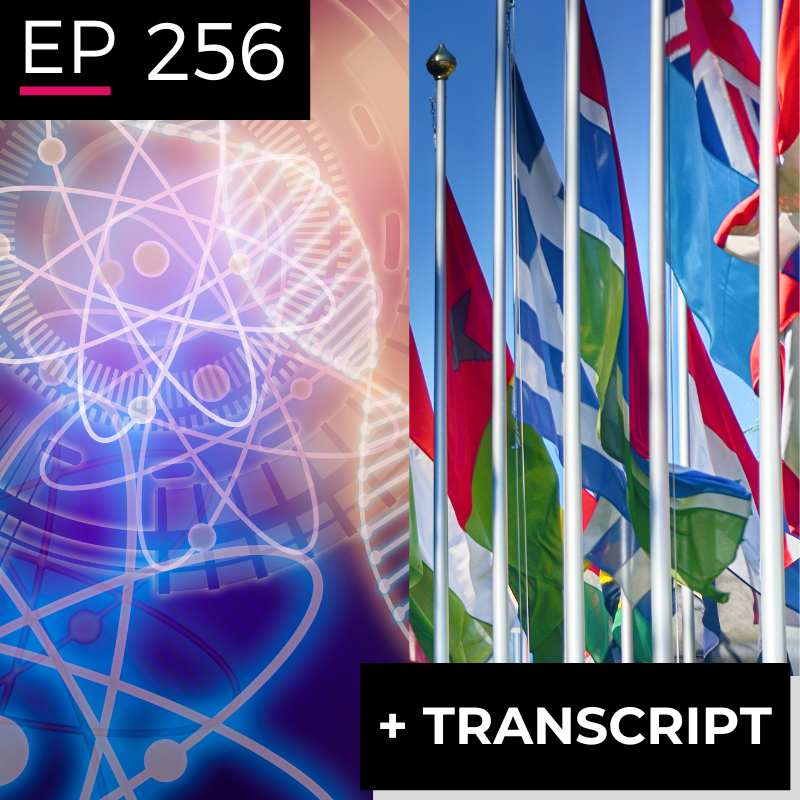
In episode 256, Peter Hayward catches up with Amna Habiba who he first met as a 16 year old winner of the Teach the Futures New Voices series some four years ago to hear how her and her thinking has developed.
Interviewed by: Peter Hayward
Links
Transcript
Peter Hayward: What is science diplomacy? Two words we would all understand separately but perhaps not see them used together.
Amna Habiba: There's not really a direct concrete definition, but one of them includes the direct or indirect use of science, scientific evidence, and scientific cooperation to inform and support foreign policy at different levels, and as well as diplomacy to support international cooperation and scientific progress. What I think of science diplomacy, and these are just my own opinions, is that it's that bringing together of these two different worlds that now that I have experienced so much of it seem to be meant to go together. We have so much scientific advancements happening, but how often do we really see them be translated, not just at a small scale, but at a larger global scale?
Peter Hayward: That is my guest today on FuturePod, Amna Habiba who returns to the Pod after a four years.
Peter Hayward: Welcome back to Future Pod, Amna
Amna Habiba: Thank you. I'm so excited to be back
Peter Hayward: It's great. It's ... I had a look. It's over four years since I first met you. Mm-hmm ... you were what, 16 year old who'd won, uh
It's Podcast 130 if anybody wants to wind back the time machine and have a listen. Yeah. But you'd been, you'd been one of the, oh, is it the New Voices program that Teach the Future run?
Peter Hayward: Young Voices ...
xx: NGF Young Voices Award. Yes. Yep.
Peter Hayward: So there's obviously been a bit happen between now and then.
Can, maybe just for the listeners' benefit, can you kind of just talk a little bit about what was going on, uh, back then when you got the Young Voices, and then just take it through there to, to get us up to now.
Amna Habiba: I had just started my initiative back in August 2020, called Global Creative Hub, which I later rebranded to BloomED. We organized a lot of events to introduce them to fields that weren't really considered conventional for girls growing up back home in Pakistan. A lot of STEM-focused hackathons and events and webinars,And I came across a LinkedIn post this NGFP Young Voices Award by SOIF and Teach the Future, and this was their first year running the award. And I remember seeing these, really big words like foresight and systems thinking and futures thinking and literacy, and I thought to myself that to some extent the work that I kind of do is help young girls imagine the possibility of having a future in something that we weren't really told growing up you could imagine into.
And I thought it wouldn't really hurt to apply, and I did, and I'm very grateful that I did because it has led me to learn so much more and discover so many more pathways that I would never have been able to imagine doing so.
Peter Hayward: Yeah, that's amazing. I mean, just again w- What-- who was supporting you such that you could start that venture?
Amna Habiba: I had a lot of support from my mom because she's the one who told me that there's these things called massive open online courses during COVID when I was off school and I had done I think around 200 virtual learning experiences in like six months.
And later on in 2020 I had decided to start my initiative and I started using LinkedIn. So I would just use that to reach out to people that I thought were doing really great stuff, uh, women in leadership fields, women in tech, and ask them if they'd be open to joining my initiative and, you know, coming in and doing a talk or partaking in a webinar or an event or mentoring the girls that I was working with.
And my mom was able to help me recruit participants within my community and also other parts of the country. And then it just kind of grew from there. I started public speaking later on in February 2021 just to get the word out there because I found that having to pay for advertisement and marketing was just not possible since I was doing this just out of my own laptop, and then applying for award programs sort of served as a great way to get that recognition because as a 14-year-old starting an initiative, it was really difficult to actually get people to listen to the work that I wanted to do So award program served as a credible way to, show that I was doing something that meant something to just my community.
Peter Hayward: Yeah, it was remarkable. I mean, I was, I was blown away when I met you, uh, that time, just how I mean, it was-- I suppose the thing that struck me about the 16-year-old Amna was just how mature and poised and, I don't wanna say confident, but prepared to just make this future happen. It was a case of, you know, you were like-- I've known a lot of entrepreneurs, and you had that, that single-minded determination that, you know, I, you know- Mm-hmm
I see in entrepreneurs that, that it doesn't matter whatever the universe throws at you, this is gonna happen.
Amna Habiba: Yeah. I think it definitely came from that realization that I've grew up in my community for, what, 14 years, and I was never really aware of the possibility that I could just imagine. And imagination is just so powerful, and knowing that I could have that power no matter what society deems a woman or a girl in my community to be able to do and whatnot, I realized that I have uncovered something that if I can share with other girls that are around me and in my community, it can really help them just know that they can be anything.
And I think that is what really drove me, you know, all those endless nights of just organizing events, putting together applications for grant programs and applying for things, even though most programs would be that, "Oh, you're under 18, you can't really apply." And I think that's where it was really nice to have programs like NGFP Young Voices where they did cater towards under-18-year-old, uh, students who were looking to drive change in their communities and in society at large.
And being able to just bring it all together and take that leap, that was the one time that I did something that I clearly did not really know what I was applying for. I mean- ... foresight was the term. It was very foreign to me, but I did.
Peter Hayward: You did. So that's the platform. That's-- So that's 2022, but we're now here four years later.
So fill us in on from that point to where you are now
Amna Habiba: Well, I joined Teach the Future in, I think early of 2022, and I helped out with World Futures Day, which was the annual gathering of futurists around the world, both young and older, to talk about the future of pretty much anything. And I found that just the team working behind Teach the Future, like especially Peter Bishop and Lisa and Lourdes was just so, open and welcoming to all of the award winners into the community, and they were trying to build this idea of futures outside of just the school, because Teach the Future started focusing on the school and education and curriculum, and they were trying to expand more outside of that.
And a lot of the work that I did with my initiative was focused on out of school, uh, activities and events. And I found them to be so welcoming that I remember asking Peter, like emailing him, that I would love to volunteer with Teach the Future. I really do believe in the mission and this idea that you can have agency over your future really sit- sit- sits with me so much because of my own struggles with figuring out, oh, I can do anything I would like to do or try to do, you know?
And I started working with Teach the Future. I started off as an intern. I was initially just helping out with some of the programs and helping out with tech. And then I remember one of these days with Lisa, who was my supervisor, talking about, "Oh, what would your thoughts be if we started, like, a youth network?"
And that's how the Young Voices Network was born at Teach the Future, and now, like, it has grown tremendously. I mean, I got to co-create a pilot program called the Futures Leader Program with Lisa, and then I got to manage the same award that I had applied for, the NGFP Young Voices Award, with Lisa as well.
And we just-- We've grown quite a lot, and now there's a whole youth council, and I got to just add in and work on a lot more projects to the point where in September 2024, I was able to speak at the United Nations in the Security Council for the UN Summit of the Future and tell people that foresight is important, in a nutshell.
And that kind of really just, it felt like a really full circle moment
Peter Hayward: I bet ... with
Peter Hayward: Isn't it wild when you think about it that, there you were presenting to the Security Council, and the word security is such an interesting word to put on a council because you could imagine a lot of things about building security for people.
But we just, we only think of that as a military geopolitical conflict. We don't, we don't actually attach the Security Council having a broader agenda than just war or preventing war.
Amna Habiba: Yeah. I think what I re- saw, at least at the UN,I mean, the Pact for the Future was signed and released at the summit itself, and we got the opportunity to contribute to some of the visions of the pact,I remember just, like, how important th- that moment was for us. I remember seeing Peter, Lisa and Lourdes in the audience, and then a lot of our network members throughout the action days before and after the summit as well.
I also do want to profess that I have recently stepped down from Teach the Future in March, so a couple months ago.
But the four years that I did spend working in different capacities and on different projects I got to start the Teach the Future podcast and a lot of other projects. What I really did kind of learn, in a nutshell, I would say, is that being able to have agency over your future is just not enough on its own.
You really need to also have the spaces where you're actually listened to and given the opportunity to make change happen. And I think Teach the Future did that really well, for me at least. I like to call it as my nest that I- Yeah ... spent four years just building and building and learning and meeting so many amazing people.
I mean, I was introduced to the whole foresight community and learning about this whole new world that I may never even have been able to imagine before.
Peter Hayward: And somewhere in that you left Pakistan and came to, uh, uh, Toronto or-
Amna Habiba: I, yeah. I actually spent a year in Michigan, so I did a year of high school in East Lansing, and then I had applied for universities, and I got into University of Toronto on a full-ride scholarship.
This was actually, uh, later on in 2023, which now I have just finished up my third year of studying molecular biology at University of Toronto.
Peter Hayward: Yep. And now, I mean, w- I mean, I'll ask the obvious que- I mean, it- You're doing molecular biology. You were-
Amna Habiba: Yeah ...
Peter Hayward: you know, back in 2022 or even earlier, you were trying to create STEM opportunities for young girls.
You are both showing your own agency, learning about yourself, but you're also a role model and an inspiration for many, many other people. If you look back- Yeah ... there's the kind of the Can you, does it make sense that it finished up being molecular biology in Toronto that-
Amna Habiba: Mm-hmm ...
Peter Hayward: you know, you are now?
Amna Habiba: I did grow up thinking that I would pursue science growing up. It was pretty much could only be a doctor or a teacher. And I was on the doctor path for a while until COVID had happened and I did a couple of summer programs like a computational biology program where I got to build this AI model that identified tumors on a mammogram.
And I also had a personal family member who had dealt with breast cancer. So that kind of pushed me to think a bit more about, oh, if I do want to pursue science, what would I wanna do? Because I knew I did not want to be a doctor at all. And I also think of it as kind of like a rebellious act just against what I was told I could be, but I also did not stray too far away from it when it came to choosing my program of specialization at the university.
But what I think really helped with all of the extracurricular opportunities I was able to make for myself, I mean, public speaking and Teach the Future and all the nonprofits I worked with, was this sense of I really do find myself doing something in the social sector. And now I had to find a way to connect it to science because I do also love science.
I love cells. I've worked in a couple of labs during my time here at University of Toronto. And I actually had this conversation with a colleague that I had met in Dubai (Dubai Future Forum, September 2024). So she was part of the Teach the Future network, and I was kind of complaining to her that, "Oh, you know, I really love science, but I also really love working with nonprofits and social work."
And she was like, "Have you ever heard of the term science diplomacy?" And I was like, "No, what's that?" And that kind of got me into a whole rabbit hole into, um, Geneva and the Center for Science Diplomacy and this whole new aspect that I could combine both of my interests into one pathway.
Peter Hayward: at university- So let's talk about that.
Are you gonna continue studying and go on and do masters or are you gonna now leave the university and try to find opportunities either in the social sector- Well,
Amna Habiba: that's the big question I'm still asking myself.
So I, I'm not too sure. I mean, I still have one more year of university to figure that out, but we'll have to see where, where, where this one year takes me further.
Peter Hayward: So science diplomacy, talk to me about that.
Amna Habiba: Mm-hmm. Okay. So it started off from that conversation that I had, and I came across this program that was being offered at University of Toronto where you could do research in pretty much anything anywhere in the world.
I had been taking a science communication class in my second year as an elective, and my professor was He really liked my work in my course, and I did quite well in it, and he invited me to do an independent study with him the semester after. And I thought to myself that, oh, I'm getting to write a lot of, like, science communication pieces and knowing how to communicate science effectively to the general audience and to the general public, and would it be interesting if I could try to see maybe a more policy angle, so maybe a science policy angle that I could pursue.
And this was, to me, quite a bit unconventional just because I would have never really imagined myself in a policy setting of any sort at all, just because I think there's a lot of stigma associated with being in politics growing up for me, from what I saw in my community, and there wasn't, there weren't really a lot of examples for me to even look up to.
And a lot of the work that I had done was really focused in science and tech, even through my initiatives, and the only kind of social aspect of my work had been through the nonprofits I was working with. So coming in with zero experience of science diplomacy at all, I took another leap, I guess. A lot of the things that I've done have been me taking leaps into something that feels very unknown and to some extent a bit risky,.
I'll say the word hopeful.
So I applied for this scholarship program called the Laidlaw Scholar Program here at U of T, and I got in, and my proposal for my research was focused on anticipatory science diplomacy as a framework for advancing cancer equity. So I still connected it back to my studies and my interest for science, but I also got to really spend six weeks in Geneva doing field work, learning and absorbing as much information I could about science diplomacy.
Yeah. It is quite a new term. It got coined by the AAS and the Royal Society in London in 2010 in their initial report and then re- later redefined in 2025.
Peter Hayward: It's a, it's an interesting word matching. It's almost-- You're almost juxtaposing two ideas that would, on the face of it, seem quite different.
And it's science for- Mm-hmm ... again, for mu- for much of my life and for many, many people, science is around evidence and facts and truth.
And diplomacy is around power and negotiation the art of what's possible, the art of the deal. And yet we've lived ... I mean, even in, even in your short time, you've seen how the place of science in society has been challenged- Mm
by what's going on at the level of power. We're seeing with climate and other kinds of, um, we ... You know, we're seeing with vaccinations coming out of COVID. Science is- Mm ... no longer seen as the arbiter of truth. In fact, for many people- Yeah ... science is seen to be biased. And non-science is, in some ways for many people, seen to be more truthful.
And so I think, I think the, I think now is the time for diplomacy in science, that science can no longer live on the fact that they are scientific
Amna Habiba: If we look at just the definition, which is still, there's not really a direct concrete definition, but a lot of different ones out there. But one of them includes the direct or indirect use of science, scientific evidence, and scientific cooperation to inform and support foreign policy at different levels, and as well as diplomacy to support international cooperation and scientific progress, which I'd say is still a fancy way to kind of explain how we can combine both of these areas, right?
I mean, they used to define it in three different strands as diplomacy for science, science for diplomacy, and then science and diplomacy, where basically just a play on we're using science as a power to advance diplomatic objectives or using diplomatic action to facilitate international collaboration or the direct interplay of them both.
But what I really thought, what I, I really think of science diplomacy, and this is, these are just my own opinions, is that it's that bringing together of these two different worlds that now that I have experienced so much of it seem to be meant to go together. We have so many, researchers out there.
We have so much scientific advancements happening, but how often do we really see them be translated, not just at a small scale, but at a larger global scale? When you look back at the COVID-19 pandemic, a lot of initiatives came up later when people were collaborating across countries and across borders to get true information about vaccination and possibly anything that could help prevent more deaths from happening, but also how difficult and how scrambled it felt at many points.
And I think that's a really good example of just looking back and thinking, what would things look like different or be different if we had scientific diplomacy part of the workflows? And Yeah, I think doing ... So now I get to interview people on my project that I started from actually meeting a journalist doing my research last to last year in Geneva.
we started this project called The Science Diplomat, which is basically bringing together a lot of voices a- about science diplomacy in one platform. We have an editorial and a podcast. I primarily run the podcast and will be contributing to the editorial soon.
But we bring together just people doing science diplomacy, even if they don't really term it as that, around the world, because it is a much more newer term and there's a lot of hesitancy with adopting it and calling yourself a science diplomat. So that came out of a need to just define this area a bit more for myself.
Peter Hayward: Yeah. I, look, I think it is completely necessary. I I mean, I go back quite a ways in the environmental area and watching how science wanted to almost stay on one side of the fence and pass it over the fence, so to speak, to the people in the grubby area of creating policy, that they wanted to be pure scientists.
Yeah. But at some point you have to get your hands dirty. You actually just can't do the science and then tell someone else to come up with laws and policies and ... that actually implement the science. 'Cause if you don't do that-
Amna Habiba: Mm-hmm ...
Peter Hayward: you know, we need science leading the political and diplomatic debates.
We can't just leave it for non-scientists to be the diplomats. That's my view.
Amna Habiba: I definitely think of it as a bringing together of scientists and policymakers, and I think I touched based upon this a bit earlier. Because a lot of the work and a lot of the initiatives that I saw were trying to put scientists in the shoes of policymakers and vice versa, and to get them to think in a more different way.
I mean, as a scientist in training, I've really realized that we're taught that, okay, that you're really focused on your research and trying to get that across, and the max that you do to actually communicate with the world is if you're doing public engagement, right? But then on the other hand, you have diplomats who are trying to get policies passed, get things happening, but may not necessarily be aware of maybe how timelines in the scientific world work or might not be able to translate really complex research that is happening into something that is more accessible in time enough for a policy to be published.
And that what happens because of that is that you kind of miss out on a lot of work that could be potentially helpful if you have another outbreak, for say, or just for different ... advancing different scientific goals in the world overall. But I think it really also matters within science diplomacy, the act of collaboration and cooperation across countries.
I think that's a really important part of scientific diplomacy that I really would like to echo.
Peter Hayward: And how does science diplomacy deal with the rise of ignorance? 'Cause I had a previous guest who said at the time when we're getting more information and more accessibility- Mm-hmm ... we shouldn't be surprised as futurists that what is also rising equally fast is people who are not just ignorant of science, but are almost deliberately undermining science or using- Mm-hmm
anti-science as a badge of, um, you know, almost as a badge to draw people towards them. How does science diplomacy ... Does it have a position on the people who are anti-science or peddling, what you might call false science?
Amna Habiba: I actually spent six weeks in London just a month ago working with this charity called Sense About Science.
So they promote the public interest in evidence and sound science. And how they do that, from what I got to observe during my six weeks there, and this was also a continuation of my summer program, was that there's a lot of misinformation out there, and I'm sure you've probably come across a lot of it just on a day-to-day basis.
I mean, you scroll on any social media app, and you will see tons of things that to some extent might feel real, and then you go fact-check and you find out that it's completely fake, or people wearing that badge of honor, like you said, of being anti-science. And what I've realized is this need for evidence is so crucial in a lot of the work that we are doing with how much information that is out there, but also making sure that the information that we consume is fact-checked.
And that, I think, is where good journalism comes in. So The Science Diplomat, uh, my colleague, is a UN-accredited journal that I got to work with. And all of the times when we're having conversations about the editorial or maybe on the podcast with our guests is Oh I've found out so much information, but I'm not too sure how I go about with it, and I'm not too sure if this research is really authentic.
And figuring out, like, where in the stream do you go to check things. I think it comes from a lot of internal self-determination as well. The whole drive to make sure that the evidence that you're getting or the information that you're getting actually is real, I feel, at least for me, has been more so do I feel the necessity to go and actually fact-check my information.
And most of the time it's not really a priority for people. And I think maybe as a society, and maybe within ourselves, within our communities, it's something that we need to push a bit more for towards changing. And it's not about telling people, "Oh, you know, you need to go fact-check your science or fact-check your evidence."
But starting with initiatives or with campaigns, like there is this program that Sense About Science does called All Trials, where they kind of wanted clinical trials to present the information in a more visible way, or they do this whole thing called Ask for Evidence, where people can ask scientists or people working on this research questions that they would be interested in knowing more about.
I think it's definitely a area that's being built on. I mean, misinformation is a really big challenge for society in general, and I think science diplomacy really does focus a lot more on the political interplay between scientists and policy makers Peter Hayward: Yeah. I mean, it's, it's, I mean, it's, it is a complex area. I just, I have a, I did an interview with a colleague and it'll hopefully come out as one of future pods. But she-
Amna Habiba: Mm-hmm
Peter Hayward: has just remarried after her first marriage ended when her partner passed away. And-
xx: Mm-hmm ...
Peter Hayward: she is scientific, so she is she's a fully fledged member of, you know, I believe in science and evidence and all that kind of thing.
And the person that she's ended up falling in love with and marrying is on the other political persuasion.
...
Peter Hayward: Also believes in evidence, but came- Mm-hmm ... from a different political frame. And what my friend said is, "In order to have a relationship, we actually couldn't use facts. Because whenever we had an argument, we each could point to the facts that suited our side of the argument."
And she said one of the, one of the things she's learned from people who come from different perspectives on things is to not fall back on facts, because you will never get relationship. You have to find other things to form a relationship on. It was s- it was such an interesting and, you know, I mean, as I said, it's
We would like to think that facts would bring us together. Cindy's view was facts will actually keep you apart, because everybody can find facts now that suit their argument
Amna Habiba: Science is not definite, you start from a hypothesis. We look at the scientific method. You move on through the steps to actually make it into a fact. And I think where science diplomacy really, let's say, just deals with misinformation is more so when we are having these collaborations between researchers, diplomats, and policymakers.
You're establishing a shared understanding of global challenges. I mean, if there's issues with rising sea levels in one part of the world, that may not really affect another part of the world, but maybe later on in the future it might. If you're incorporating collaboration at an early on part of time, it could potentially help to deal with these future challenges, right?
And I think it goes back to just promoting evidence-based dialogue. I mean, science to some extent is considered a universal language. There are things, there are facts about this world that just we, unless proven wrong, are going to be considered the truth. Just like, oh, the Earth isn't flat, right? And we have had the whole debate, so flat Earthers versus you know, people saying that, "Oh no, the Earth is a donut shape," for example.
You can find facts and you can find evidence points that might support your argument, but is that evidence point already supported by multiple other ones? And I think that's really where a lot of published work also is important to see is peer reviews, making sure that this information is fact-checked and can be reproduced.
And it does come from a lot of self-determination to actually go down these holes and figure out, okay, someone said XYZ at one point of time. Is this actually accurate, factually correct, and have evidence that supports it? And you, most of the time, just referring to the conversation you mentioned, people might not really have the time to do all of that.
And I think that's where science diplomacy can, to some extent I guess, play a role, is making sure that knowledge that is shared across borders is knowledge that is factually correct and evidence checked. Because you're not just caring about the future of your own community, but more so the future of other communities as well.
And I think that's where it's really important that we have more proactive prebunking, I guess.
Peter Hayward: Yeah. I think that was ... I think you've anticipated my next question, which is the relationship- Mm-hmm ... of things like science diplomacy and ... you've been, you've been hanging around with futurists now for a few years.
Amna Habiba: Yeah.
Peter Hayward: Do you see them both supporting one another?
Amna Habiba: I would be a bit biased, right? Because I worked with Teach the Future for a really long time, and then I got to do my research last summer on anticipatory science diplomacy, which basically is more of a model that brings together scientist, diplomats and leaders to prepare for breakthroughs before they actually do something to society.
And I think that interplay between science diplomacy and anticipation was quite interesting for me to explore as well, because you're looking at these things that haven't happened yet, and you're trying to anticipate, because in futures, we don't predict the future. We always anticipate for the future, and there's always multiple futures.
So if you're bringing together these two stakeholder groups, these two main stakeholder groups, and trying to get them to think together, okay, if... This is a lot, there's a lot of long-term thinking in- involved in this as well, and I've had a lot of debates about priorities for governments to actually get short-term goals because they'll match election cycles versus work on longer term goals, which would actually be more helpful for scientists because a lot of research that happens today could benefit us in, let's say, the next 5 years or 10 or 25 years or 50 years.
But those might not always be good timelines for perhaps a government official that's trying to get reelected again, right? And I think that's where the whole field of anticipatory science diplomacy acknowledges that kind of gap, I'd say, and tries to deal with it by intentionally bringing together the scientists and policymakers and knowing that, okay, let's try to imagine what the future could look like or what could be preferred futures if we were to invest in quantum, for example.
at CERN, they're doing this initiative,, the Open Quantum Institute, that is bringing together scientists and diplomats, and it's an initiative that was supported through the work GSDI is doing.
So GSDI is the Geneva Science and Diplomacy Anticipator. And it is quite interesting to see that they have this whole tool called a radar, where they bring together the scientists and policymakers to think about trends that could possibly happen in the next five, 10, and 25 years. And what I noticed through my readings were, was that, and through my research, was that when it came to the 25-year time scape, timeline, they were less hesitant to think of ideas that may seem unconventional.
'Cause in the next five years, you try to be a bit realistic, right? Like, it's like, okay, maybe we will have an advanced version of XYZ vaccine, or maybe we'll be able to have more nanotechnology in another part of this or XYZ, right? But then you go to 25 years, and you see that the constraint of time doesn't really feel important anymore, and then you see the scientists trying to think of things that may not really seem plausible at all at the moment, but there could be pathways or there could be research funded and supported for that, so that when we, again, going back to that same statement, if we were to have the next outbreak, we are prepared for it.
Because you can never predict the future. You can only prepare for it. Mm-hmm. And I think that's what anticipatory science diplomacy does really well, is it helps you understand, if I want to be prepared for the future, which I don't really know what is it gonna be, what are the skills and what are the a- what is the actual research I can do right now that could be useful in the future, but may not really have a direct application in the moment?
Peter Hayward: Yeah. That's ... Therein lies a, the balance between short and long-term electoral cycles and what, and what we need for the future is, of course, a, uh, a tricky one that w- you know, a lot of people wrestle with. So when you look around at the world now as a seasoned futurist/scientific diplomat- ... what are you paying attention to?
What's getting you excited? And if also, what's getting you a little bit concerned or making you focus more on?
Amna Habiba: I think throughout the four years of my time at Teach the Future, I was always hesitant to call myself a futurist. I mean, we even had a whole youth futurist title for me to use. And then even with The Science Diplomat, I talked to my colleagues, Jawn and Bupe, and I'm always like, "Oh, like, do you think we can call ourselves science diplomats?"
Like, I mean, we ask our guests that all the time, but they've been working in these different fields that w- are now kind of working together for years and years, and they still feel hesitant to call themselves a science diplomat. I mean, we had a guest on our podcast very recently who terms themselves as a science translator over a science diplomat, which I found really interesting, right?
Because there's a lot of play on terms, but it's not like it's a very new term. It's been ... The work that people do as science diplomat has been happening for years and decades before that. It's just that now we're giving it a more simpler term to refer to more easily. And going back to your question, I think what makes me hopeful about the future or just the state from looking f- just from the state of the world at the moment, considering everything that's going on politically, I feel hopeful knowing that there's uncertainty, and that uncertainty can help us achieve really good things or really bad things, depending on what we decide to support and what we decide to fund.
And I hope that maybe in the next, let's just go back to the 5, 10, 25 years that we've been talking about, I am able to, to some extent contribute to that idea of bringing together these two worlds even more closer than they are. Because in political times as is right now, when it just feels so fragmented, just looking at any headline, I mean, you look at science cuts across the US, you look at fundings being removed and everything that's going on, it feels, it feels like
Sometimes it does feel like y- we're really going in a downward spiral just in terms of how backward science is to some extent becoming. But then you hear about these initiatives about, u, or students working and going to these gatherings researchers and scientists and coming back to their countries and working on initiatives at home.
I mean, I get to see a lot of this happening during my time at, in Geneva, uh, with UNITAR and with different organizations and bodies. I f- do feel hopeful in the sense that at least in today's day and age, with how connected we are digitally, it is much more accessible and easier for a student, let's say back in Karachi, Pakistan, to be able to explore something that may not have been really accessible growing up for a lot of people today.
And for people to just, know that there could be a lot of things that we can do if we just make the right choices. And sometimes maybe not even just the right choices, but the best choices in the moment, which may or may not be the right ones, but could be helpful for the next generations. And personally, what gives me the will to just continue being hopeful would be my two sisters.
I have an 11-year-old sister and a three-year-old sister, and a lot of my work and a lot of my motivation now comes from knowing that I want to contribute to a world, to a future, to multiple futures where they can feel safe and have the opportunities to pursue what they would like to do. And I mean, it's a pretty broad idea, but it does come from just trying to make sure that the world is still a good and safe place to live for our future generations.
Peter Hayward: Yeah, I think, I think your younger sisters are very fortunate having a very cool and interesting older sister who, uh- ... has kind of shown that really you can be as outrageous about creating a different future for yourself as you can dream. There's really-
xx: Yeah ...
Peter Hayward: there's really no limit to what a person can achieve.
I have to ask because, I mean, four years ago, you, you grabbed the MOOCs that were popping up and turned that into the STEM platform. Of course, the technology- Mm-hmm ... which is happening right now, of course, is AI and how quickly that is being adopted into many, many things. Would, is that something, I mean, y- again, you mentioned it, that, you know, you were doing part of your science was actually using AI to help identify, uh, breast cancer in our readings.
But how do, how does science and AI sit together for you?
Amna Habiba: I think there would definitely be a lot of aspects to just AI. I was a person that at the start of the whole AI rise, I was quite skeptical, which would be something that I didn't really expect myself to have is skepticism. But I think over time I've realized how much of a powerful tool it can be if used in cor- in the correct ways, which is very important because there's a lot and lot of misuse of AI in today's day and age.
I mean, we have deepfakes, we have so much misinformation spreading because of AI-generated content and media and visuals. I think when it comes to my own views about how it can be used, it's definitely helping reduce a lot of The gaps that arise in between translation. I think AI is ... And I don't mean translation in literal format, I mean it more so when you're trying to translate information over from one group of people to another one and that kind of bridge and gap in between.
Let's say I'm a scientist and I'm trying to, you know, work on something, work on a problem, but I might not really know how to communicate that, I guess. I mean, you just start from there, right? And a lot of the times, you know, you usually find yourself trying to simplify things and trying to understand them.
But at the same time, without not really fully losing the essence of the research, which is really important. I think I'll go back to something my professor taught me in my science communication class, is that you don't want to assume that the general public is per se dumb. Because when we're trying to communicate science, a lot of people get lost in that idea of, "Oh, I have to dumb down my science to explain it."
People are smart. People have been part of this information age for a while and know that there's a lot of information out there and can make assumptions to some extent. What you do want to do is make it accessible and there's a difference between accessibility and dumbing down information per se. I think a lot of the times when I get to work on projects or work on things, I think AI is really helpful to facilitate more so this cooperation and kind of address things that may not directly be easily addressable when you're just working on something yourself.
'Cause we're so used to, at least as scientists sometimes working in silos, that we may really be so in-depth into a niche that you may not realize how to just communicate with people outside of your niche, right? I think that's where I personally feel like it would be amazing to see AI continue to grow and is helping people across different groups and across different fields connect better.
Peter Hayward: Yeah, I agree. I think for me, the power of AI is when you have context and so you can look at what AI gives you. So you could give it a scientific paper and say, "Turn this into a policy document," and it will turn it into a policy. But you would then you would look at the policy through the lens of science and you'd go- Mm-hmm
"Yeah, that's good. No, you got that wrong." So it's when you don't have the context, you can't tell whether AI is hallucinating- ... or, or helping. So it, the responsibility is always on you, the user.
Amna Habiba: For sure. Definitely. '
Peter Hayward: Cause you can't pass the responsibility off to the technology.
Amna Habiba: Nope. I think a lot of the work, especially with my computational biology projects, was not that, oh, we're not trying to replace the doctor, but more so serve as an aid, as a support for another cross-check perhaps.
Just like how within when you're writing a paper, you end up finding a lot of grammatical m- errors that might not have been intentional, but you have spell check mechanisms and tools and dictionaries to kind of consult, right? I find AI to do that in a way that feels, at least to some extent, more automated, is that there's always something to double-check, but that doesn't mean that it removes your responsibility as a r- person or a citizen to do that yourself as well.
Yes, it's al- it's like saying, "Oh, I'd like to have another pair of eyes over my paper, you know, and see if there's any edits or things I should move around." But that doesn't mean that you still don't go back and do it yourself
yeah.
Peter Hayward: Thanks, Amna. So what are you working on now?
What are the things that, you're currently doing that listeners could be interested in?
Amna Habiba: I, like I mentioned a bit earlier, I'm working on my project called The Science Diplomat with couple of colleagues. And I would love for people to join in, listen to our conversations that are happening on the podcast, read our editorial.
We have a couple of series that go out. But also, I would like to kind of use this opportunity to just put a message out there. I mean, I started working and trying to figure things out and making my own path six years ago. I'm 20 now. I started when I was 14. And I still don't think that I have done quite as much as I think I could potentially do, and that's just the power of believing in the things that young people can do.
And I know a lot of the times when we have these programs, and I mentioned this earlier, is that, oh, how do I really, you know, go about trusting someone if they don't really have that credential or this big organization connected to their name? And I'd like to use this as an opportunity to just remember that supporting young people to be part of these spaces where decisions are being made for their future is, and always will be, a priority through my work going forward.
Peter Hayward: Look, it's for one, I was, I was delighted to meet you about four years ago, and I have been delighted to support and encourage you.
And it's been fantastic to have you back on the podcast and to see how much you've grown- ... and to get excited for what's next for Amna.
Amna Habiba: Yep. Well, let's see if I end up in grad school or decide to just do something completely unconventional again.
Peter Hayward: Thanks, Amna, for coming back on the pod and spending some time with the community.
Amna Habiba: Thank you so much for having me. It was a pleasure to be on the podcast.
Peter Hayward: Thanks to Amna who took us through the fascinating and overdue discipline of Science Diplomacy. And keep your eye on Amna as she seems to one to watch out for. FuturePod is a not-for-profit venture. We exist through the generosity of our supporters. If you'd like to support the pod, please check out our Patreon link on futurepod.org. I'm Peter Hayward. Thanks for joining me today. Till next time