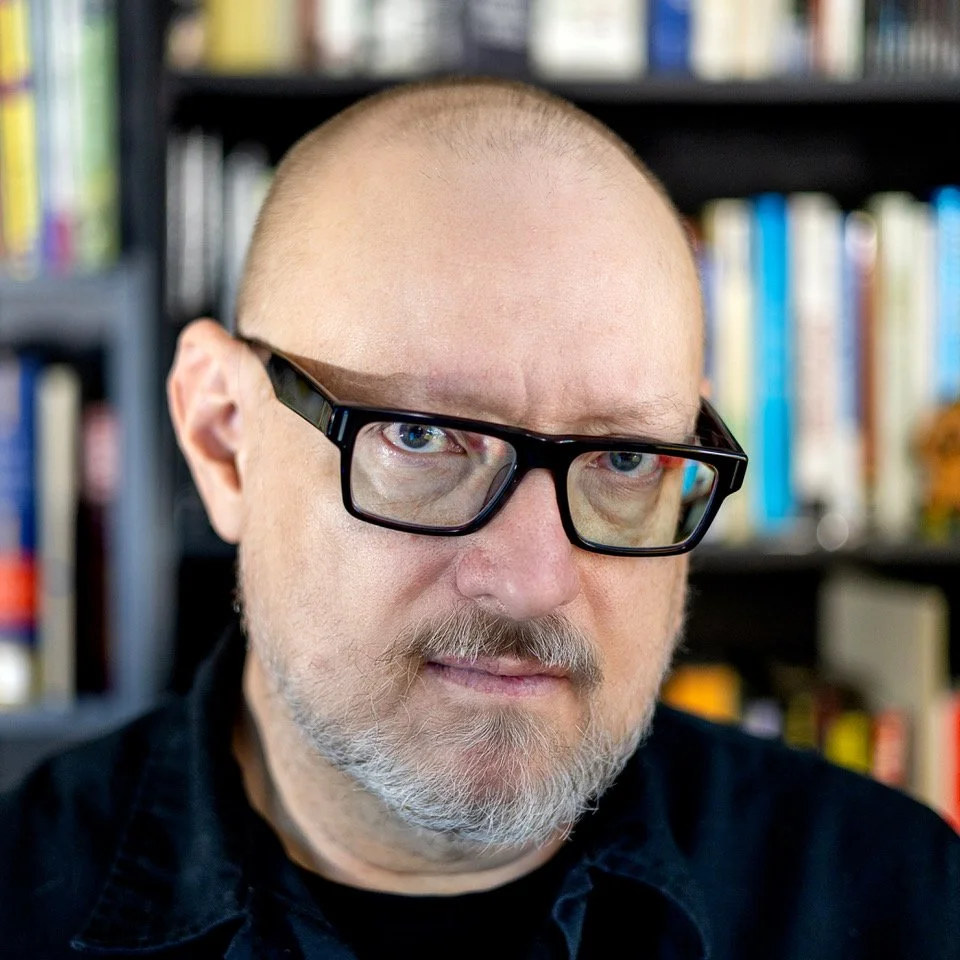
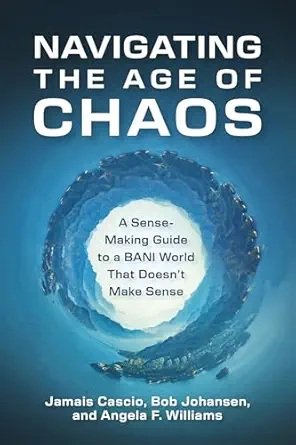
In episode 239 Peter speaks to Jamais Cascio who with Bob Johansen and Angela Williams co-authored Navigating the Age of Chaos - A sense making guide to a BANI world.
Interviewed by: Peter Hayward
Resources
Transcript
Peter Hayward: Describing our world as VUCA meaning Volatile, Uncertain, Complex and Ambiguous was useful to the formulation of strategy and policy. And then we heard another word, BANI. What was that?
When I first bumped into BANI what I responded to Jamais was VUCA is a description of the world we're in. What I saw with BANI was, yeah, it's a description of the world, but it's also how I feel in that world? It's how it feels on the inside.
Jamais Cascio: It's not just how it feels on the inside. It is how the outside feels on the inside. What it's like to live in this world is you feel, it feels brittle, it drives your anxiety. And it feels incomprehensible. And nonlinear. Nonlinear is a bit of a stretch for a lot of people. It's very mathy, but really it's a reflection of the vast imbalances. In nature and in politics and in the world in general. The imbalances, the lag, the seeming disconnection between what we do and what effect we have.
Peter Hayward: That is my guest today on FuturePod. Jamais Cascio, One of the authors of the book Navigating the Age of Chaos.
Peter Hayward: Welcome to Future Pod Jamais.
Jamais Cascio: I'm happy to be here.
Peter Hayward: Thanks for joining us. Your thinking and your work has been something that I've taught students studying foresight for a while, and it's a pleasure to meet you.
Jamais Cascio: I'm actually, I'm embarrassed to hear that.
Peter Hayward: Yeah
Jamais Cascio: I'm really glad that it makes—it is both an honor and kind of overwhelming to think that the ideas that I've come up with have been useful to people around the world.
Peter Hayward: At the pod we start with the story question. What is the Jamais story? How did you get involved with the Futures and Foresight community?
Jamais Cascio: Blame my wife.
No. I, no, actually a little bit before that I was in graduate school in the 19… 1980s, early nineties studying international politics.
But I just kept veering towards looking at models and scenarios and I actually had an opportunity to travel to the RAND facility to look at their computer model for international conflict which was, it was called the RAND Strategy Assessment System.
And it was interesting in that the lowest level friction that was possible in that simulation was roughly the equivalent of the Cuban Missile Crisis
Peter Hayward: lowest level.
Jamais Cascio: And it struck me as very interesting that they did not have ways of thinking about political futures that didn't immediately jump to moving tanks around the board.
Peter Hayward: Wow.
Jamais Cascio:
Yeah, so this always had been part of the way I looked at the world, long interest in science fiction, et cetera. But in ‘95, ‘94, ‘95 my wife got a job at place called Global Business Network founded by Peter Schwartz and Stewart Brand.
Peter Hayward: Peter Schwartz
Jamais Cascio: Yep. A few other folks. And she got a job as an assistant to Napier Collins, one of the founders.
And they had various events and I would start showing up to events and oh my God, these people are doing exactly what I wanna do. That's Stewart Brand, the Whole Earth Catalog guy. And just, it was amazing to be in the midst of these folks.
Now I had been paying the rent by doing computer network work. Just computer admin stuff. I had left graduate school prior to getting my PhD because I wanted to write—in ‘92, I wanted to write a dissertation on the impact of emerging technologies on international power. And I could not get a committee.
Peter Hayward: Ah,
Jamais Cascio: and, my, my main advisor was like all for it. I thought this was a really great idea, but I had some professors say, no, that's too speculative. And some professors saying, no, that's too historical.
And they started trying to push me towards doing, “wouldn't you like to help professor A with his work on the international global textile trade regime?” No, I would not. And so I just after a lot of pulling out my hair a lot of action and trying to pull out my hair and just going crazy, I decided to walk away from the program. So I still don't have an official PhD.
But so it goes.
But GBN, it turns out in ‘95 GBN needed somebody to do computer network stuff. So I immediately applied and got hired and they quickly found out that I could write as well, and they started pulling me in on projects to do scenario work and to help write pieces and to talk about technology to clients.
But they told me no, we're not going to promote you. We don't promote from within.
Peter Hayward: Alright, that's fine.
Jamais Cascio: Do what you do. And then I got a job in Hollywood and I moved down, my wife and I moved down to Hollywood in ‘98. And I worked for a few years doing tech advice for and story advice for various science fiction shows. Nothing ever made it to screen.
And so I had this surreal experience of being very successful in terms of getting work, but extremely invisible because nothing I did ever made it up. And then I got pulled up to San—back up to San Francisco in 2000 to work for an innovation services company doing scenario work.
And that company promptly died in 2001. And that was the last time I worked full-time in an office. Because after a year or so of thinking, “oh my God I'm unemployed and I'll never get employed.” I realized I'm not unemployed, I'm a freelancer. And so I started doing game design and all sorts of, and scenario work.
And 2003, I co-founded a website called World Changing. Which from I was the main writer for two, from 2003 to into 2006, and it was one of the first websites to take both climate change seriously, but also take it from the perspective of what do we do about it.
Peter Hayward: right?
Jamais Cascio: So rather than just simply trying to ring the alarm or to talk about how, how horribly screwed we are. I, we were really focusing on, okay, so what do we do? What are the things we need to pay attention to? How do we think about a world where we succeed?
Peter Hayward: Yep.
Jamais Cascio: And I, that was a lot of fun to work on, but after doing a lot of writing, I think I, I think the… it worked out to in 2005, I wrote 1200 pieces for the website, and I just burned out.
Okay. And so floated around for a little bit. In 2007 in the Institute for the Future, they had been fans of my work at World Changing, so they invited me to participate and that became my home for a while. Nothing, never an employee officially, but always in, brought in on projects and doing writing pieces and working a lot in their Ten Year Forecast program, but at the same time doing various public presentations, speaking around the world.
I had remarkable experiences of speaking in places—like I got to talk about human extinction at the Berlin Natural History Museum surrounded by dinosaur fossils. I got to, I got, I was in Singapore the night that Barack Obama was elected.
Just that kind of traveling the world, getting to do interesting stuff. And that has been… that was my life up through, oh, I don't know about through COVID, basically. Doing work with the institute, but doing, writing for journals, writing for New Scientist and did a long piece on geoengineering for the Wall Street Journal and a long piece on brain augmentation for the Atlantic. Just, it was a really remarkable time, and then COVID hit, and so I've been primarily working from home.
However. Alright. And a long meandering story.
Peter Hayward: Lovely story by the way. I've just gotta pause back onto that dissertation.
I love the fact that from one academic perspective you are speculating. And the other one is you are too historical and I can't think of a better way unintentionally to define the core of what we do.
Jamais Cascio: Oh yeah. I've actually, I make a point of talking about foresight work as anticipatory history.
Peter Hayward: Yeah. Thank you.
Jamais Cascio: Because if you look back at the kinds of dynamics we think about when we think about historiography, when you think about the engines of change in our history, issues around demographics and technology and what happens with the environment and just all of the things that make up the course of where we are today that leading us to where we are today, and you apply those same dynamics forward. That's the root of doing foresight work.
Of thinking about how all of these processes that have shaped our history will continue to shape our history going forward.
In 2018. at the 50 year anniversary of Institute for the Future, because it's been around for quite some time, I gave a talk that was ostensibly about the impact of trust and chaos in the international system looking ahead and in that, I offered up the term BANI, B A N I. Now BANI was a reflection of VUCA, which was a term that came out of the US Army War College back in the late eighties as a way of describing the post-Cold War era.
VUCA is an acronym, meaning Volatile, Uncertain, Complex, and Ambiguous. And if you think about what the world looked like in the 1990s and into the two thousands, that's actually a pretty useful framing for the end of the Cold War, the emergence of a worldwide web, all this kinds of stuff that was happening.
It was unsettling and disruptive, but ultimately understandable.
Peter Hayward: Yep.
Jamais Cascio: Even the Global War on Terror, after 9/11 when, at that point a lot of business consultants started using VUCA in their work. But even after that, it was still, we could see that things were awful, but we understood what was happening.
Peter Hayward: Yeah.
Jamais Cascio: There weren't many there were, if the surprises happened, they were surprises of timing, not of process.
Peter Hayward: Yeah.
Jamais Cascio: But that started to change in the 2010s, by the mid 2010s. And so with BANI, I suggested actually let's think in terms of chaos, in terms of the world being Brittle instead of volatile, Anxious instead of uncertain Non-linear instead of complex and Incomprehensible instead of simply ambiguous.
Peter Hayward: I love that last one. I think the last one is what, probably my favorite. That kind of hooked me on the whole thing.
Jamais Cascio: It's the one that people tend to push back on
because you get a lot of people saying there's nothing that's truly incomprehensible.
Yeah. Humans can understand anything if we put our minds to it. Yes, but.
It's, this is not about under the process being under incomprehensible, the, the mechanisms being incomprehensible. It's about. You know it, it's essentially asking what the hell?
Peter Hayward: Yeah.
Jamais Cascio: Or more, more rudely, what the fuck?
Peter Hayward: Exactly.
Jamais Cascio: Yeah,
it is the, it's the W T F of, of BANI. But including WTF would make it totally unpronounceable.
Peter Hayward: right. And this was the, and as I understand it, the history is that. Bob was in the audience for that talk.
Jamais Cascio: He was in the front and front of the room.
And there was polite applause at the end. Bob said, I don't see a need for this. We have VUCA, we don't need anything else. However, there were visitors from Brazil. In the back of the room and they came up to me afterwards and said, yes, this is exactly it. This is right. This is what the world looks like.
Peter Hayward: This is my world.
Jamais Cascio: Exactly. Exactly. And I continued to noodle around with the idea, but it didn't really draw any attention until 2020 and the onset of COVID-19 and in April I was persuaded to publish publicly on, on Medium a version of my talk focusing on BANI as this way of, thinking about the world in the COVID era.
And I was thinking, okay, I got Paul applause. The first time around this is gonna be, I'll get some people reading it and some people commenting. It exploded.
Peter Hayward: Oh yeah, it did.
Jamais Cascio: It was just, within days it had thousands of reads.
And the strongest reactions came from people in the global south, people in the developing world.
And that just really hit me hard. It's like I've actually come up with an idea, come up with a phrasing that is meaningful cross-culturally.
It doesn't just apply to old white guys from California, but actually is meaningful for people around the world. And the last few years has been [me] trying to turn that into something useful.
And Bob came around on the idea. And one thing that he had done with VUCA is he'd come up with something that generally got to be called VUCA Prime.
Which was a positive version of VUCA, of Vision, Understanding, Clarity and Agility. Alright. He said usually you should have a positive version of BANI.
And eventually came up with positive BANI of bendable. Because lemme step back. I had actually come up with responsive, respon, how do you respond to this world? I didn't talk about resilience and empathy and improvisation, and he said no.
It needs to be in the B A N I to make it a parallel. So Bendable for resilient, Attentive for empathetic, Neuroflexible for improvisational.
And Interconnected for inclusive. Yeah. Now you notice that inclusive also starts with an I, but especially when we were writing, working on the book inclusive had started to become a bad word in American business
okay. Let's go With interconnected. It means it's close enough and I'll use inclusive in abundance throughout the description of it. But so yeah, bendable, attentive, neuroflexible and interconnected is a way of talking about how do you respond to the body environment. Not as a way of solving problems, but as a way of coping, essentially
Peter Hayward: When I first bumped into BANI and it was before the medium piece, but certainly, and the differences I saw, what I responded to Jamais was VUCA is a description of the world we're in. What I saw with BANI was, yeah, it's a description of the world, but it's also how I feel in that world?
Jamais Cascio: Yes!
Peter Hayward: It’s about my internal state facing a world that is like that. People responded to positively was someone definitely could say, we don't need it to describe the outside, but it's how it feels on the inside.
Jamais Cascio: It's not just how it feels on the inside. It is how the outside feels on the inside.
Peter Hayward: Yes.
Jamais Cascio: What it's like to live in this world is you feel, it feels brittle, it drives your anxiety. And it feels incomprehensible. And nonlinear, nonlinear is a bit of a stretch for a lot of people. It's very mathy, but really it's a reflection of the vast imbalances in nature and in politics and in the world in general. The imbalances, the lag, the seeming disconnection between what we do and what effect we have.
Peter Hayward: And I'm wondering too, then things like people losing trust in elites and institutions and also the belief of leaders that can operate with an internationalist perspective. Do those things just become casualties that. People in a world feeling as they do from the BANI perspective, yeah. Is that also one of the, knock on one of the sort of effects of that?
Jamais Cascio: I don't know if I would say it's an effect or a cause.
Because among—I have to admit that one of the major triggers for me thinking about what eventually turned into BANI, was looking at what Donald Trump was doing in his first administration.
And all of those issues and all of the elements of pushing back against norms and giving up on international institutions and, being dramatically opposed to empathy for other perspectives. That was rampant already. And so I'm not sure if BANI is both a reflection of it and helps to explain it.
Seeing that our systems are so brittle helps us or can drive us to think to losing trust in institutions because those institutions could fall apart when stressed in, in ways that we just simply didn't expect.
Democracy as a brittle system is not something that people talked about 10, 15 years ago it. But now that's, in many respects, that's what we think of as— democratic systems are inherently fragile.
Peter Hayward: You look at Western Democratic, in Australia, we are looking at our major conservative party as is losing position, hand-over-fist to a kind of more extreme version of right wing.
Politics the same that has happened in England, the same that has happened in France. The same that has happened in Germany. The same that has happened in the Netherlands.
Jamais Cascio: Happened in Italy and happened in Japan.
Peter Hayward: Exactly.
Jamais Cascio: And oh. And the United States.
Peter Hayward: And the United States. And it's not just that, it's causing people to lose confidence in what was here pre BANI, so to speak, but also it's what people are voting for the future. We need people who don't see the world this way, who don't act the way this way. They're certainly not following BANI Prime in the way they're responding. They're going, no, we make it simpler. We go back to other ways of understanding the world.
You, you become stronger rather than being brittle, you become more independent than you become interdependent.
Jamais Cascio: I have to tell you something that, that I haven't talked about on any other conversation, and that is I've been thinking about what are the negative BANI? Because if original recipe, BANI is really descriptive of the world and Positive BANI is prescriptive about how you should, what you should do to cope.
Then what we can call Negative BANI would be the dynamics that are, we should be prescriptive, that is, this is what we should not do. Or rather, these are the actions and forces that will worsen or can worsen original BANI and it's Brutal, Abusive, Non-consensual and Isolated.
And brutal and here the phrasing brutal efficiency, but it's the idea of what you do without care for the consequence.
Abusive is, cruelty, doing what you can to undermine the undermine, undermine others.
Non-consensual is doing what you can to. Act against the wishes of others or the wishes of others, simply do not matter. You will act regardless.
And isolated is this the disconnection, the intentional disconnection of someone from their support systems, from advice, from other perspectives, and we can see all four of those processes that work to date.
Now I'm still thinking about this. This is very much a Yeah. An alpha version of the idea, but just, this is something I've been thinking about is how, what do we see in terms of what various leaders are doing out there? That are contrary to what a positive, what Positive BANI asks us to do. And there's a lot of stuff out there that's very upsetting.
It's really—as you undoubtedly know, it's really hard to be, emotionally hard to be a futurist right now.
Peter Hayward: Yeah.
Jamais Cascio: To work in the foresight field because it is incumbent upon us to pay very close attention to what's happening in the world, to pay close attention to how these systems intertwine, and it is so damn depressing to do! It's this feeling, this Cassandra feeling of knowing that this process, it only has a bad end or is very likely to have a bad end and nobody's listening.
Peter Hayward: Yeah. Stewart Stewart Candy at one of our
Jamais Cascio: love Stewart's, a good friend,
Peter Hayward: Stewart, in a podcast with me.
He referred to a talk he gave in Mexico where he coined the phrase, our emotional burden. As a field, and it's not to paint us as martyrs or heroes.
Jamais Cascio: No.
Peter Hayward: But to do our job, we have to go to places. We have to more than just draw up a quadrant where the world could go like this. We have to go into that world and imagine that world. We have to imagine how people would do in that world and how would they behave? Not because we want it, but we have to understand it. If we don't understand it, then it just becomes a blind spot.
Jamais Cascio: And Herman Kahn back in 1961 came up with really the phrasing that embodies this: thinking the unthinkable.
And his role when he came up with this concept and the, and he came up with essentially what became scenario planning was thinking about the things that nobody wants to think about and that's what we do. We don't, that's not the only thing we do. But it's part of what we do.
Peter Hayward: Again, what you saw with Rand was they'd boiled into their thinking a negative version of the world that everything went from. And what I think you are trying to do with BANI is say, let's not bake the cake so we only start with the negative as the starting point. Let's actually start to the other side. 'Cause that's the point of the book, that's the point of the work with Bob and Angela is we have a choice when we're in BANI. Which path do we choose towards? And obviously as a field, generally we're voting for goodness sake.
Jamais Cascio: It is… it's difficult. A lot of people that I work with on a regular basis have a tendency to refer to me as a doomsayer. As a doomer, and it's easy to fall into that caricature…
Peter Hayward: Yeah.
Jamais Cascio: …sometimes, because a lot of what I write about and what I think about are the unintended consequences, the unanticipated implications of the choices we're making today, particularly around, but not exclusively, climate. And it is easy to describe the results as being really disastrous. Catastrophic, even.
I've been trying not to do that though. If you go back as far, as 2003 to 2006 at Worldchanging. Yes, we fully embraced the idea that things were really bad. We completely, we were clear-eyed about it, but at the same time we wanted to focus on what do you do about it.
Similarly, when I describe a world, the world today as being BANI, or the future's being BANI. It's not because I'm sitting here cackling about it, it's because I want us to act, I want us to do what we can, to push back against that.
I make a real point—if you get a chance to look at the book, Navigating the Age of Chaos. From Barrett, Kohler publishers, came out in the end of October of last year.
I write, I have a chapter towards the end that's all about futures thinking and how to apply that from the BANI perspective. And it's really about being honest about what consequences are, but not being stuck in the consequences.
I talk about the extinction events that Earth has seen over the millennia, over the millions of years. There was one about 250 million years ago that the scientists refer to as the Great Dying, because 80%, at least 80% of all species on the planet died out. The one that happened 65 million years ago that wiped out non-avian dinosaurs. That was a little one in comparison.
And then from that, I talk about the couple of times when the human species came really close to being wiped out. About one, about 60 to 70,000 years ago, one, about a hundred thousand years ago, human humankind was brought down to about a hundred to 200, breeding pairs. Basically about 500 people. And the nine, nearly 9 billion people we have on earth today all come from those, that small set of breeding pairs, tens of thousands of years ago.
We are able to succeed even in the face of catastrophe, and I want people to recognize that it is possible to push back against misery. One of the stories that I tell in the book, and it's actually prompted initially by, as I mentioned, I gave a talk at the Berlin Natural History Museum with surrounded by dinosaurs.
One of the fossils there was of Archaeopteryx. And the Berlin specimen of Archaeopteryx is probably the most famous version of it, which was a dinosaur with feathers. And the fossil was very clear that this was a dinosaur covered in feathers. It was a bird and a dinosaur.
And what we have come to realize is that dinosaurs never went extinct, they just evolved into birds. And have been incredibly successful. People so often use the metaphor of the dinosaurs as big lumbering thing. Doomed to extinction. No. The dinosaurs a metaphor for something that faces the unimaginable turns around and adapts past it, figures out how to thrive in the face of catastrophe.
And that's what I've been trying to think about in my work is how do we thrive in the face of catastrophe? But doing so requires us to [be] truly honest with ourselves about the nature of that, of those potential catastrophes. And so the first half of the book is really depressing.
First half of Navigating the Age of Chaos is I go into the details of how boning is man, or how BANI is manifesting. What brittleness looks like going forward.
What kinds of things are driving our anxiety, what kinds of choices are we have to make in terms of climate, in terms of AI. And you come out of that half of the book just being wiped out by it.
But then move into the second part of the book and it's talking about, okay, how do we cope? And it's not looking at, what if the solutions to these particular problems. It's more how do we adopt the mindset that allows us to push back against catastrophe? How do we live with ourselves and live with others in a way that succeeds in pushing past misery? How do we adapt?
And so that's what Positive BANI is.
The idea of being resilient is not about, facing a particular problem. It's about how do we make ourselves able to withstand the unexpected, an unexpected shock.
Peter Hayward: Yeah. We don't have solutions for how to do it now because we haven't faced this set of circumstances before. We don't have mindsets individually. We certainly don't have institutions and governance systems that match into that. And that's fine because that means we get a chance to work out what they are, how do we build them, and using our view that the future is already here, it's just not well distributed. If we actually look at the things that people are trying, we actually start to get some ideas about what might work.
So let's now unpack Positive BANI. 'cause it really, it's the point of the book and it's the point of, us having this chat.
Jamais Cascio: Alright, so the B in Positive BANI is Bendable. That is resilience and adaptability. The idea that we need to be able to withstand a shock, and that sometimes means pushing back against hyper efficiency. It sometimes means pushing back against the need to have everything right, every time. It's being acceptance of failure as a learning process. It is having backup supplies.
I talk about living in California my whole life, I've had to make, had to be thinking about earthquakes. And so I have an earthquake kit that will allow, my household to be okay for a couple of weeks, even if everything's been cut off, water and power, et cetera. I have built in some resilience to our lives. And that's actually pretty common in California. And in fact, there are at least anecdotes of companies that have built out plans to deal with a big earthquake that would do something like knock down a bridge or something like that, wherein they needed to make sure they had systems to allow their workers to work remotely.
[They] were better able to cope more quickly with COVID because they already had that mindset of how do we adapt to something unexpected? And so the, the logic of the Bendability chapter is really about how do you build up that mindset of resilience? What do you do for yourself? What are the personal actions that you take? How do you change your thinking about the world? How do you work with others?
Peter Hayward: I would imagine too, there a big one. There is you are, and you can't do it by yourself. Yes, you can build an earthquake kit that gets you through the first. Two, two or three days, or two or three weeks.
But you also need to have the beginnings of how do we then, how do we then bring the community together? How do we start to look at the resources that are around us? How do we spread sufficiency, resilience to, a collective, rather than “I need to have everything to survive as an isolated person.”
Jamais Cascio: And that's a nice foreshadowing of, the larger positive BANI argument is that these four elements, the bendable, attentive, neuroflexible and interconnected, they are themselves interconnected. They all support each other and interact with each other. So yes, bendable and resilience, that's great, but you do but as you say, you have to be able to do so with a community, or you'll do it better if you're able to do it with a community, you're able to do that better if there is a measure of empathy in your reaction to others, and so A is Attentive, that is empathetic, recognizing that other people are going through, when you're going through something awful, recognize that other people may be going through that something awful too.
The story that I sometimes tell when talking about this is just a very tiny example of what this looks like, and that is you're driving on the freeway and somebody zooms by you going far faster than the speed limit. Maybe they're driving really erratically or very dangerously. For a lot of us, our first reaction is, what a jerk, or something more explicit.
But maybe it's better for your blood pressure to sit back and think, wow, that person's in a real hurry. I wonder if they're trying to get to a hospital to see a dying partner.
Or I wonder if they're really trying to get home 'cause they have to go to the bathroom or there's something where they have a reason for doing that. Yeah. It may or may not be true. But that's not the point. The point is to change your framing, change the way you think about others in the world, to recognize that sometimes other people are experiencing really bad stuff too.
Peter Hayward: Was that on a previous podcast where you talked about your wife's t-shirt?
Jamais Cascio: Oh, yes. Yes. And my wife has this lovely t-shirt that she wears. “In a world where you can be anything, be kind.”
And that in, in many respects, that sums up the entire attentiveness chapter. It's kindness to others and to yourself. A lot of us have a real, have issues around depression or anxiety where we are prone to blame ourselves for problems or to take on the mantle, the weight of things not working right.
And it’s necessary, just as necessary, just as it's necessary to be kind to others. It's necessary to be kind to ourselves.
And I know this sometimes come across, comes across as being flaky or it's probably don't have many people referring to hippies these days. But that sense of, it's all very nice.
But yeah, being nice is good. Being empathetic is good. I am astounded and horrified that there are political movements, especially in the United States, that have actively called empathy evil. It's just so jarring to me because the whole point of being a civilization is to help each other thrive.
Peter Hayward: Yeah. And again, our field is that we have to understand why for some people strength is a positive way to respond to BANI. Blame is another perfectly adaptive response to say, I'm feeling this way because of them and what they're doing. We shouldn't be surprised with the rise of toxic male influencers. We shouldn't be surprised by the Andrew Tates and these people popping up.
Jamais Cascio: No, we shouldn't be. And you're right, that those, you know the strength, the blame may seem like you a lotte to a BANI world, but they don't have persistence. They don't have longevity. They're not futures perspective, they don't have a futures perspective. They're not forward looking. Yep. And I think one of the things that's important about the positive money framing is that it's intentionally forward looking, which is, not a surprise with it's coming out of my work and having done this for 30 odd years, Bob's work, having Bob Johansen's work having done this for even longer. Angela F. Williams is the third author of the book and she was the, up until very recently, president and CEO of United Way Worldwide. She very recently announced her retirement and she didn't write much of the text. But what she did was, over the course of conversations, really helped to explain and illuminate for us what it's like to live in a BANI world. Because what United Way has the on the ground people globally helping people deal with chaos. And so her participation in the book is very much around helping us really have some depth of understanding of what it's like to live in chaos and moreover, what kinds of steps we can take to push back.
And so the N, neuroflexible, is really a way of talking about improvisation. It is not following the checklist, not following established rules or paying attention to what those established rules are, and evaluating whether or not they remain appropriate.
In a world of chaos, in a world where things are changing really rapidly because systems have broken down, because systems are not behaving the way we expect them to, it is critical that we pay, that we think about what we're doing. That we have some ability to imagine what the consequences are, and choosing appropriately.
The term from neuroscience that I really love is fluid intelligence, and the definition being how you know what to do when you don't know what to do. That is, when you don't have a predefined set of responses, how do you respond? What is your capacity to imagine different kinds of outcomes.
And so really the neuroflexible, the improvisational is being willing to accept that you may not understand things perfectly and you need to reevaluate. You need to look again and ideally ask others. Ask, ask for other perspectives. 'cause sometimes what looks like, what may look one way from your perspective, may look completely different from another.
And that leads us into the last one, the interconnected. This is a world where simply knowing more may not be enough. You need to know differently. That is, you need to be able to see, from that 360 (or, whatever the 3D version of that would be), from that, that much wider perspective.
Of what's happening in the world because you're not gonna know everything as smart as you are, you will not know everything. And if you are surrounded by people who think like you, collectively, you're not gonna know everything. Yeah. And collectively you may have a blind spot that you simply aren't aware of.
And so bringing in perspectives, points of view, opinions, beliefs that differ strongly from your own, can be really annoying, can be highly upsetting, but extremely useful.
Because at the very least it gets you to reconsider, to rethink, what you are imagining about the world, what you're seeing in the world.
Peter Hayward: When I get a chance to talk to leaders, Jamais, I often say, rather than have a great idea, I think it's better if you have a half good idea and you put the half good idea out to your people who work with you and let them make it a good idea
Jamais Cascio: Yes. Yes. There is a truism online that I've seen.
I was online back in the Usenet day, so back in the eighties. But, and there's a truism that's been around for decades, and that is, if you want to get an answer to a question, intentionally offer up the wrong answer.
Peter Hayward: Yeah.
Jamais Cascio: And so if you have a question about something rather than asking, because that doesn't seem to get people pushing back or thinking about what the answer might be.
It's stating with great confidence, something wrong. And you'll get so many people arguing with you. You'll learn the right perspective. You get the right answer that way.
And I think that is a microcosm of what you're talking about that. It's not enough to ask, it's to have a structure in mind of what you might be wanting to understand and what you might be thinking about, but being willing to listen to other points of view on it, to really try to form that much larger, that much larger idea.
Peter Hayward: And it's better if other people think it's their idea or they, or their own part of the idea
Jamais Cascio: Right. And in a way that's actually been one of my struggles in with BANI is.
It, I am like, like I said before I'm extraordinarily overwhelmed and honored to have come up with something that people globally find useful, but I also have to recognize that at some point in the not too distant future, my name will be disconnected from it.
No one will be thinking about Jamais Cascio along with BANI.
It's just gonna be BANI. Do you know the names of the people who came up with the VUCA concept? Not many people do. I do, but I can't remember their names off the top of my head. But I have to be okay with that. [Warren Bennis and Burt Nanus]
Peter Hayward: Yeah.
Jamais Cascio: I have to recognize that this idea is bigger than me.
And I've been really trying to, both with this, with BANI in particular, but really this broad, this broader set of thinking about the world doing so from the perspective of it's not about me it's really about how do we see the systems and how can we share that understanding
Peter Hayward: We are getting towards the end of our time. We could obviously go on for four hours, but we don't tend to do that with the podcast. Oh, yeah I'll give you two questions to, and then you can close it off with this, who reads the book and why? And if people want to know more about how they engage with you or the work or the ideas or the communities, then where do they go?
Jamais Cascio: Alright the second one is a quicker answer, so you want to go to ageofbani.com
Peter Hayward: Okay. We'll include those links on your page. And that [will] actually be [in] your transcript.
Jamais Cascio: It'll take you to connections for all three of the authors, but also take you to a couple dozen videos where each of us explain aspects of BANI, aspects of the book. Other essays about BANI and just really get a better sense of what we're talking about. So ageofbani.com, that's easy.
I am surprised by who's reading the book because among the variety of people who have responded to the book, responded to the BANI concept in it more broadly, one of the largest communities to do so is the community of coaches. That is people who are advisors to other people, helping them think about, personal coaches, life coaches, those people who are there to try to help you think about the world.
And sometimes it's from, it's a perspective of a therapist. Sometimes it's a perspective of a professional counselor. The largest number of responses I've gotten from people who approach this from the perspective of how do we help others think about how to cope with the world, and, thinking about it, it makes perfect sense.
It is not just that group, of course. People who are leaders—we really wrote this with the idea of people who are leading organizations can really help be helped by the ideas in this book. Both the positive BANI and also the original BANI.
The core BANI concept because a lot of people don't really recognize the scale of the challenges that we're facing. The brittle chapter, or the chapters where I talk about what's happening with climate, with the North Atlantic meridianal overturning, basically the circulation in the Atlantic that helps keep Europe relatively warm.
And what's happening with climate change and now what's happening with Antarctic, these are terrifying.
For, and a lot of people don't recognize just how terrifying the situation really is and the actions that need to be taken. I know that we can do it. It's just, getting us to do it.
Getting, making sure we take that action anyway. So leaders, people who are trying to guide institutions, organizations, governments, nonprofits, people who are advisors to leaders, it really is, this is a book that is helpful for people trying to understand the bigger picture and turn that into action.
How do we operationalize thinking about the future? This, there's a whole chapter on doing that. How do you speak to leaders about this? There's a whole chapter on doing that. You know how, what are the steps that we can take to cope? Each of the four positive money chapters has a way of, work has worked based on the work of Judith Moskowitz in the University of Chicago, about how do we cope with trauma, how do we cope with chaos?
Each of these, each of the chapters is tells us, gives us a narrative. Helps to describe this larger world, both in terms of what is challenging us and in terms of how do we strengthen ourselves and how do we tell the story.
One of the things that, one of the points that Bob makes in the book is that leaders are storytellers. That their job is to construct a narrative for their organization that gives a. A sense of purpose. Why do we do what we do? What is our vision here and what is the meaning of our organization?
And what we're trying to do with Navigating the Age of Chaos is help to inform, help to illuminate what that, what the optimal narrative would be for the chaos that we are all experiencing, everywhere in the world.
Peter Hayward: Jamais, I've had a one of those. Happy to sit at your feet and listen to you tell the story. 'cause as I said, I've taught your stuff for quite a while in the foresight course at Swinburne. And I've, as I say, I've had a wonderful time just appreciating both the depth and the core humanity in the work that you and Bob and Angela have done.
I wish you all the best with the book and that this
Jamais Cascio: thank you
Peter Hayward: that we can, as a society and as a planet, choose positive. The response to take us towards positive BANI. But thank you for everything you've done and thanks for spending some time on the pod.
Jamais Cascio: Oh, absolutely. My pleasure. Thank you for having me.
Peter Hayward: Thanks to Jamais. I think their work on BANI is very helpful, especially as it shines some light on the interior capacities that we each need to develop to adapt to an incomprehensible world. Check out their website, it has some great resources. Future Pod is a not-for-profit venture. We exist through the generosity of our supporters. If you would like to support the pod, then please check out the Patreon link on our website. I'm Peter Hayward. Thanks for joining me today. Till next time.